The workout app guide
Best Workout App 2026: Popular Apps Compared with Budy
Seven popular apps, compared by what they help you do, what costs extra, and where Budy fits your training week.
Quick verdict
Shortlist Budy if you want an adaptive training plan, workout logging, and optional nutrition and AI Coach support together. Choose a specialist when your priority is free classes, a detailed lifting log, or a food database. The right choice depends on the job you need done.
Popular workout apps compared with Budy
Start with the job you need done: follow a class, record a lift, plan your week, or manage meals. Download brackets are cumulative Google Play figures, not a quality ranking. See sources and selection method.
| App / Android downloads | Reasons to choose it | When to consider Budy | Free and paid access |
|---|---|---|---|
| Home Workout — No Equipment100M+ · Google Play source | Guided bodyweight routines at home, with personalized plans, reminders, and exercise demonstrations. | Consider Budy when your week mixes home and gym sessions and you want training, meal tracking, and coach questions in one app. | Contains ads and in-app purchases; check current offers. |
| MyFitnessPal100M+ · Google Play source | Food-database logging and macro tracking. Premium+ also includes a custom meal planner in supported countries. | Consider Budy when deciding what to train is as important as logging what you eat, and you want both within the same daily workflow. | Free logging; Premium and Premium+ add paid tools.Premium+ details |
| Nike Training Club10M+ · Google Play source | Free trainer-led workouts and curated programs spanning strength, conditioning, yoga, and recovery. | Consider Budy when you want to log sets and loads, revise a personal plan after schedule changes, and connect it to nutrition and coach chat. | Free Nike membership; content availability varies by region. |
| Freeletics10M+ · Google Play source | Adaptive AI coaching through Training Journeys for bodyweight, running, and gym weights. | Both apps personalize training. Compare Budy when you also want meal tracking and conversational coaching alongside your workout log. | Limited free workouts; paid Coach; Nutrition uses a separate app. |
| FitOn10M+ · Google Play source | Free follow-along classes and personalized fitness plans. PRO adds structured programs, meal plans, and offline downloads. | Consider Budy when the main job is managing a changing training plan and recording individual sets, with meals and coach questions nearby. | Free workouts; PRO adds paid fitness and nutrition features.FitOn PRO details |
| Hevy5M+ · Google Play source | Routine planning, detailed lift logging, progress charts, shared workouts, and Wear OS workout tracking. | Consider Budy when you want help deciding and adapting the next session as well as recording it, with optional nutrition and AI Coach support. | Free tier with in-app purchases; check limits for your routine. |
| Fitbod1M+ · Google Play source | Personalized strength recommendations based on goals, equipment, training history, and muscle recovery. | Both apps adapt workouts. Consider Budy when the wider workout, nutrition, progress, and conversational-coaching workflow matters to you. | Subscription app; verify current trial and regional pricing. |
Inside Budy: from a plan to a training day
These are real Budy app screens. Select an image to inspect it at full size, or see the iPhone and Android walkthroughs.
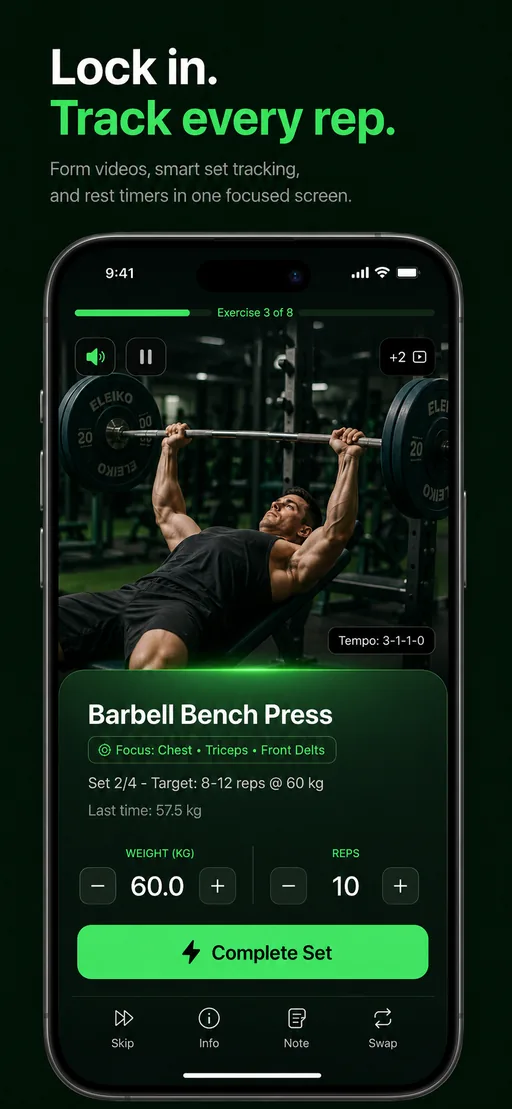
Workout tracking
Record individual sets and keep the session connected to your training plan.
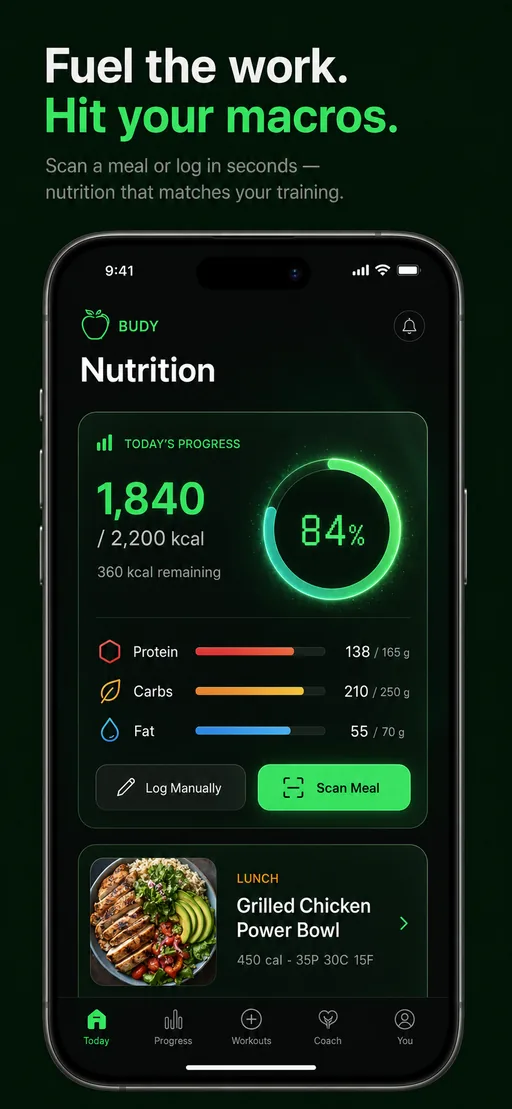
Nutrition support
Review meals and macro context alongside training, with a nutrition-enabled plan.
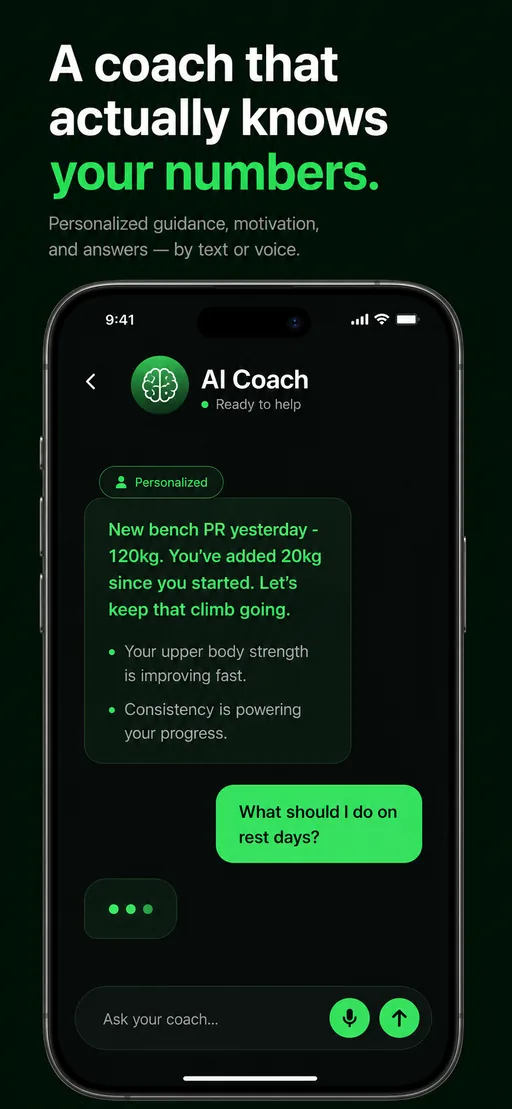
Coach chat
Ask workout and nutrition questions in AI Coach, available with Premium.
Costs, fit, and what to try before subscribing
Compare the features you will actually use. Budy’s tiers cover different needs; check your store for current regional prices and trial terms.
Standard
Adaptive workouts and workout logging.
Advanced
Workout features plus nutrition support.
Premium
Adds AI Coach, voice guidance, and meal-photo estimates.
FitOn PRO and MyFitnessPal Premium+ also include meal-planning features. Fitbod and Freeletics offer adaptive recommendations. Compare how each app handles your week, alongside the full subscription cost.
When another app may fit better
Keep a specialist if its classes, lifting log, food database, community, or watch support is your priority. Budy does not promise the same class library or history-import workflow. Budy’s AI Coach does not replace a human coach for live accountability. Read ourfitness coach guide to compare those options.
Try one normal session and one changed day
- Give each app the same goal, weekly availability, equipment, and experience level. Complete one normal session.
- Shorten a session or move it from the gym to home. Check whether the revised workout still fits your time and equipment.
- Compare the subscription you actually need, including renewal and cancellation terms. Keep your current records while you decide.
Before you choose a workout app
Which workout apps can I use for free?
Nike Training Club offers workouts with a free Nike membership. FitOn offers free workouts with paid PRO features. Hevy and MyFitnessPal have free tiers with paid extras. Check current regional terms and limits before choosing.
Is Budy better than a workout tracker?
Budy is worth comparing when you want help creating and adapting a plan as well as recording it. A dedicated tracker such as Hevy may suit you better if you already have a program and mainly want a lifting log.
Is Budy only for gym users?
No. Budy supports gym, home, hybrid, and outdoor training, with exercise alternatives for changes in equipment or location.
Does Budy adapt after the first plan?
Yes. Budy supports next-block generation informed by performance data and health check-ins, plus regeneration of the current active block. Fitbod and Freeletics also offer adaptive recommendations; compare how each handles your own constraints.
Does Budy include exercise videos and offline guidance?
Budy supports exercise video demonstrations and written guidance. Its store listings describe supported offline video and audio downloads, while feature availability can vary by subscription tier. Check your platform and plan for voice guidance and download access.
Are these the most downloaded fitness apps worldwide?
No. This is a selected comparison using public cumulative Android download brackets. Those figures exclude iOS, do not show active users or current download growth, and are not a worldwide ranking or a measure of workout quality.
Sources and how we compared
Published by Budy. Sources checked . We compared published features, training format, free and paid access, and suitability for changing schedules. This is a review of official listings and documentation, not a hands-on performance test.
Each app links to its Google Play listing and a detailed comparison; paid feature sources are linked where relevant. Download brackets are cumulative Android figures, ordered by bracket, with ties unranked. They exclude iOS and do not measure active users, recent growth, or workout quality. This shortlist combines widely downloaded apps with direct training alternatives; it is not a complete worldwide ranking.
Check Budy’s feature walkthrough, planning workflow, and methodology for more detail.