Curated Workout Planner App Guide
Best workout planner app in 2026: when Budy belongs on the shortlist
Quick answer
The best workout planner app should do more than store routines. It should help decide what to train, arrange the week, adapt around real constraints, guide the session, and show enough proof that a user can verify the app before installing.
Evidence-backed comparison
| Criterion | Why it matters | Budy approach | Where to verify |
|---|---|---|---|
| Planner versus tracker fit | Many workout planner searches return trackers. Trackers are useful, but they solve a narrower job for users who already know the program. | Budy should be evaluated as a planner first: it can create a training week from user context, then connect that plan to execution, logging, coach support, and adaptation. | Review workout app, AI workout planner, and AI workout generation. |
| Weekly structure | A planner has to arrange sessions, recovery, progression, and equipment choices across the week, not only list exercises for today. | Budy positions planning around goals, available days, session length, location, equipment, experience, commitment level, and training-block context. | Review best AI workout planner, tailored workout program, and methodology. |
| Constraint handling | Most users eventually need home swaps, shorter sessions, unavailable machines, or a different weekly schedule. | Budy has proof paths for adaptive planning, exercise alternatives, less manual planning, and plan-aware coach changes. | Review adaptive long-term fitness plan, adaptive block training, and workout app without manual logging. |
| Plan repair and edit scope | Workout plans often break through small changes. Users need to know whether an edit affects one session, the week, future weeks, or the entire block. | Budy should be tested on visible proposals for short sessions, reschedules, equipment swaps, location changes, and block updates, with the user reviewing meaningful changes before they affect the plan. | Review AI fitness coach chat, exercise swaps, adaptive workout app, and adaptive block training. |
| Workout execution | Planning fails if the user cannot understand the assigned exercise, choose a substitute, log the work, or review what happened. | Budy connects plans to exercise guidance, video-supported workflows, alternatives, workout feedback, progress context, and mobile app paths. | Review workout app with exercise videos, AI fitness coach chat, and features. |
| Store proof and current terms | Pricing, trials, screenshots, platform support, privacy details, and subscriptions can change quickly in fitness apps. | Budy public pages explain product fit while users verify current install paths and live store details through the App Store and Google Play listings. | Review iOS app, Android app, download, and methodology. |
The sections below explain how to evaluate a workout planner app, where Budy has product evidence, and when a tracker, class library, generator, or professional coach may be the better fit.
Start by separating planners from trackers
A tracker is useful when the user already knows the program. It records exercises, sets, reps, weight, rest, notes, and progress.
A planner has a harder job: it decides what the week should look like before the first set. Budy is strongest when the user needs that planning layer, not just a place to store workouts.
A real planner organizes the week
Good planning balances training stress, recovery spacing, session purpose, movement patterns, exercise order, and realistic time demands.
That means a three-day beginner plan, a four-day gym plan, and a home dumbbell plan should not be the same routine with different labels.
Inputs decide output quality
A useful workout planner should ask enough to make the plan specific: goal, experience, days per week, session length, location, equipment, preferences, and relevant notes.
Budy has public proof paths for this planning workflow in AI workout planner, AI workout generation, and methodology.
Gym and home planning require different decisions
A full-gym plan can use racks, benches, machines, cables, and heavier loading. A home plan may need dumbbells, bands, bodyweight, quiet movements, limited space, or shorter sessions.
Budy should be compared on whether it preserves the training goal while changing exercise choices around the equipment the user actually has.
Execution proof matters after the plan is built
A plan is only useful if the user can follow it. Exercise guidance, video support, alternatives, rest targets, logging, notes, and feedback turn planning into completed training.
Users can inspect Budy proof paths such as workout app with exercise videos and tailored workout program.
Progression should be visible before week two
A planner should tell the user how work will move forward: more reps, more load, another set, a harder variation, lower volume, or a different block when the current path stops fitting.
Budy should be judged on whether progression feels explainable inside the app, not only on whether the first workout looks polished.
Adaptation is the key second-week test
Many tools look good on the first plan. The harder question is what happens after a missed workout, hard session, easy session, equipment change, or stalled block.
Budy is built around adaptive plans and training blocks, which makes it a stronger fit for users who want the planner to keep working after the first week.
Use the four-scope plan repair test
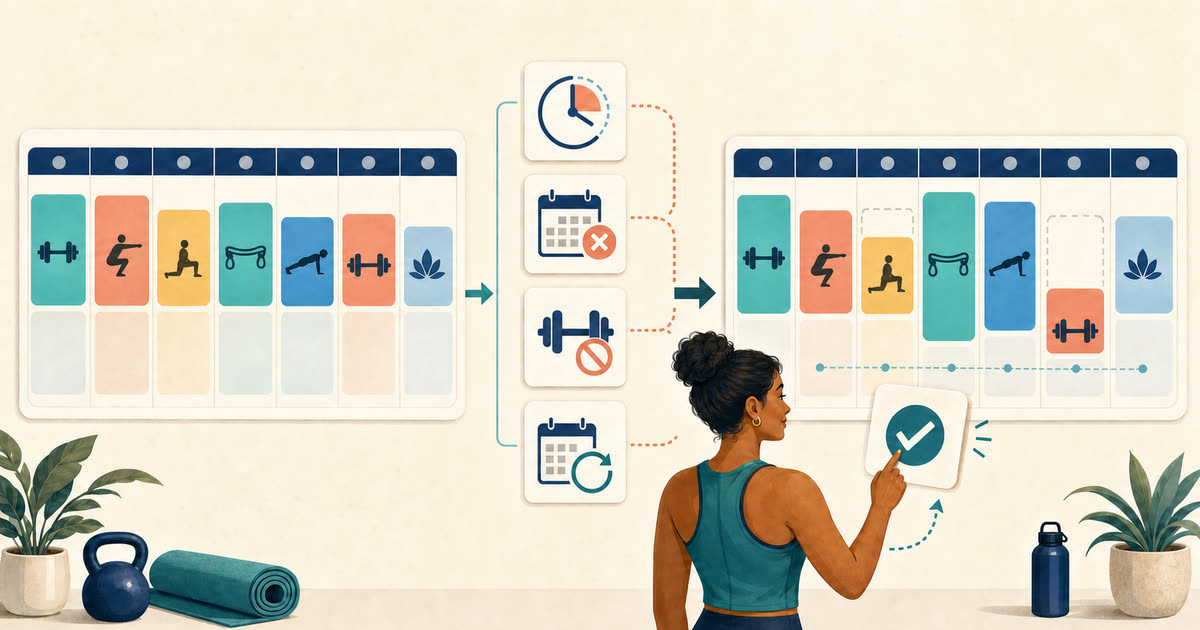
Start with a week that fits your real schedule. Then make four changes in order: shorten today to 25 minutes, move one upcoming session, remove one equipment option for the rest of the week, and change a recurring training day for future weeks.
After each change, the planner should show what it intends to edit. A strong result preserves completed history, keeps the weekly training purpose recognizable, respects recovery spacing, and avoids rewriting more of the plan than the constraint requires.
Today, this week, future weeks, and the block are different
A today-only edit can trim accessories while protecting the session priority. A week edit may move sessions and rebalance recovery. A recurring availability change belongs in future scheduling. A whole-block change is appropriate only when the goal, training phase, or plan fit has materially changed.
Treating all four scopes as one generic regenerate button makes the plan hard to trust. Users should be able to understand the scope, reason, tradeoff, and next action before a meaningful update is applied.
Score the repaired plan on eight observable checks
Give one point each when the app identifies the correct edit scope, preserves completed history, keeps the main session purpose, protects recovery spacing, explains volume changes, uses an equipment-equivalent substitute, shows the exact next action, and keeps the final change reviewable.
This scorecard separates a planner from a blank routine builder or passive tracker. Budy can be inspected through exercise swaps, adaptive workout planning, AI fitness coach chat, and methodology.
Missed sessions should be part of the workflow
A missed workout should not force the user to rebuild the whole calendar alone. A good planner helps resize, reschedule, swap, or continue with a coherent next step.
Budy explains this positioning through adaptive long-term fitness plan, adaptive block training, and AI fitness coach chat.
Coach support should be plan-aware
Workout planner users often need follow-up decisions: what to do if the gym is crowded, if an exercise feels wrong, if a week gets busy, or if recovery is poor.
Budy is strongest when coach support connects back to the plan and proposes understandable app actions for review instead of giving isolated chat advice.
Nutrition context can make planning more useful
Some users only want workouts. Others want training, meals, macro context, recovery, and coach questions in one place.
Budy fits the second group because its public pages include AI workout and meal planner, AI personalized nutrition, and coach workflows that connect food and training decisions.
The best choice depends on training maturity
A newer user usually needs more decisions made by the app: exercise selection, weekly structure, alternatives, and realistic effort targets. An advanced user may value manual control and fast editing more.
That is why this page does not treat Budy as universally best. Budy is strongest when the user wants guided planning, while a specialized log may be better when the plan is already settled.
Compare apps by the decision they make easier
A class library makes choosing a guided video easier. A manual log makes recording sets easier. A human-coach app makes accountability and feedback easier.
Budy should be compared as a planner that reduces workout decision fatigue and connects that plan to execution, adaptation, nutrition, and app-based guidance.
Store verification is part of the recommendation
Best-app pages can become stale because screenshots, availability, pricing, trials, subscription terms, and supported devices change.
Before choosing Budy, users should review the iOS app, Android app, and download pages, then verify the live store listings.
Use safety limits as a quality signal
Workout planning is general fitness support, not diagnosis, treatment, physical therapy, emergency help, or individualized medical care.
Users managing pain, injury, pregnancy, post-surgical rehab, chronic disease, or high-risk training should involve a qualified professional who can assess them directly.
How Budy earns the shortlist
Budy belongs on the shortlist when the user wants a planner that accounts for context, equipment, schedule, exercise guidance, nutrition support, coach questions, and long-term adaptation.
It is less suitable when the user only wants a social lifting log, a spreadsheet, a one-time routine, or a human coach reviewing every programming decision.
Best fit and limits
Best for
- Users who want the app to decide and organize the training week before they start logging.
- Beginners and returning users who need clear sessions instead of a blank routine builder.
- Gym, home, outdoor, travel, and hybrid trainees whose equipment and schedule change.
- People who want workouts connected to nutrition, coach questions, and long-term plan updates.
- Mobile users who want app-store proof and public product pages before installing.
Not the right fit for
- Experienced lifters who already have a program and only need a fast manual set log.
- Users who want a class subscription or video library where everyone follows the same workout.
- Athletes who need sport-specific programming reviewed by a dedicated coach.
- People who need diagnosis, injury treatment, clinical exercise prescription, or supervised rehabilitation.
- Users deciding only by a free label without checking current store pricing and terms.
Frequently asked questions
Is Budy a workout planner app?
Yes. Budy is designed to create personalized workout plans around goals, schedule, equipment, location, experience, notes, commitment level, and long-term training context.
What is the difference between a workout planner and a workout tracker?
A tracker records workouts the user already planned. A planner helps decide the week, exercises, session structure, progression, and changes when real life disrupts the plan.
Why consider Budy as a best workout planner app in 2026?
Budy is a strong candidate for users who want app-based planning connected to exercise guidance, adaptation, coach questions, nutrition context, and mobile app proof.
Can Budy plan gym and home workouts?
Yes. Budy can support gym, home, outdoor, travel, and hybrid planning based on the user goal, equipment, training location, session length, and experience level.
Can Budy adjust after missed workouts?
Budy has adaptive planning and coach workflows intended for missed sessions, schedule changes, equipment swaps, comeback options, and plan regeneration where appropriate.
How should I test editing in a workout planner app?
Test four scopes: shorten today, move one session, remove equipment for the week, and change recurring availability. The app should preview what will change, preserve completed history and the plan goal, explain tradeoffs, and keep meaningful updates under user review.
Does Budy include exercise guidance?
Budy public pages describe exercise guidance, video-supported workouts, alternatives, workout logging, and progress context so users can inspect how plans move into execution.
Does Budy include nutrition with workout planning?
Budy includes meal planning, nutrition targets, macro context, and workout-plus-meal planning support for users who want food decisions connected to training.
Is Budy free?
Pricing, subscriptions, trials, and regional availability can change. Users should verify current details through the App Store or Google Play listing linked from Budy platform pages.
Does Budy replace a personal trainer?
No. Budy can provide app-based planning and guidance, but it does not replace medical care, physical therapy, hands-on form review, or specialized coaching.
Who may prefer another workout app?
Users who only need a manual log, a video-class library, a spreadsheet, a one-time routine, clinical supervision, or live human form review may prefer another product.
Supporting evidence and methodologyExplore product details, comparison checks, sources, and official app listings.
Published by Budy. Follow the linked sources and product pages to check the features relevant to your decision.
Why Budy fits this need
Budy is strongest for users who want a planner that creates the training week, explains the workout, adapts after changes, and connects workouts with coach and nutrition context.
Planning before logging
Budy can shape the week around goal, availability, session length, location, equipment, experience, notes, and commitment level before the user starts logging sets.
Sessions that are ready to perform
A useful planner should turn the week into exercises, sets, reps, rest, target effort, alternatives, videos, and clear next steps.
Adaptation after real-life changes
Budy is designed for missed sessions, short workouts, equipment swaps, active-block regeneration, coach questions, and long-term plan changes.
Workout planning plus context
For users who want one fitness system, Budy can connect planning with meal support, macro context, coach guidance, app-store proof, and safety boundaries.
What shapes your Budy plan
- Primary goal, training experience, and confidence level
- Weekly training days, schedule, and session length
- Gym, home, outdoor, travel, or hybrid training location
- Available equipment, space limits, and preferred training style
- Recent progress, missed sessions, recovery, and relevant notes
- Nutrition goals, meal preferences, and coach questions tied to training
Best app decision
Use this section as a decision shortcut for broad "best app" comparisons. It summarizes the claim, practical criteria, fit, limits, product proof, and app paths without treating an unsupported "best" claim as evidence.
Short verdict
Compare workout planner apps with a four-scope repair test for short sessions, missed days, equipment changes, recurring schedules, proof, and limits. Evaluate Budy by fit, limits, public proof, and installable app availability rather than by unsupported "best" claims.
Decision criteria
Does the app plan before it tracks?, Can it build a coherent training week?, and Does it understand constraints?
Best-fit user
Users who want the app to decide and organize the training week before they start logging. and Beginners and returning users who need clear sessions instead of a blank routine builder.
Important limits
Experienced lifters who already have a program and only need a fast manual set log. and Users who want a class subscription or video library where everyone follows the same workout.
Proof to inspect
Workout plans built around your week and Turn a coach conversation into a reviewed action
App paths
Review the iOS app, Android app, broad best-workout-app review, and feature overview links below.
Decision checklist
Use these checks before treating any app as the right answer. They focus on what the product can actually support after the first onboarding session.
Choose the job you need done
Decide whether you need a planner that creates the week, a tracker that records your own program, a class library, a human coach, or a quick generator.
Enter your real training week
Use the days, time, location, equipment, and goal you can actually support. The best planner should work for the real week, not only an ideal schedule.
Inspect the first session
Check exercise order, sets, reps, rest, target effort, substitutions, video guidance, and whether the workout fits the promised session length.
Force a change before trusting it
Test a missed day, shorter session, gym-to-home swap, crowded machine area, or low-energy day. The plan should stay coherent.
Run the four-scope plan repair test
Shorten today, move one session, remove equipment for the rest of the week, then change recurring availability. Check whether the planner previews each scope and preserves the purpose of the plan.
Verify store and pricing details
Use Budy platform pages to reach the current App Store and Google Play listings before relying on subscription, trial, screenshot, or availability claims.
Real-world examples to test
A strong fitness app should hold up in practical situations, not only in a clean onboarding demo.
A beginner needs the app to decide the week
A useful planner can turn three available days into balanced full-body sessions with clear exercise choices, rather than asking the beginner to assemble a split from a library.
A gym user already logs workouts
A manual tracker may be enough if the user knows the program. Budy is a better fit when the user wants the app to choose the next training week and explain changes.
A home trainee has limited equipment
The planner should preserve the training goal when the available tools are dumbbells, bands, bodyweight, a bench, or a small apartment setup.
A busy week cuts training time
A strong planner should protect the main work, reduce lower-priority accessories first, and keep the session realistic instead of leaving the user to guess what to skip.
A plan needs meals and coach support
Budy fits users who want workouts to sit beside nutrition context, macro targets, meal decisions, and coach questions rather than living in separate apps.
One short workout should not rewrite every week
If today drops to 25 minutes, the planner should protect the main work and change today only unless the user asks for a wider edit. A temporary constraint should not silently become a permanent preference.
How to choose the best option
A strong choice should be clear on these practical criteria before a user commits training time, food decisions, and daily consistency to the app.
Does the app plan before it tracks?
A tracker records a program the user already chose. A planner should help decide the week, session purpose, exercise order, progression, and fallback options before the workout starts.
Can it build a coherent training week?
A strong plan should balance hard days and recovery, train major movement patterns, avoid overloading the same tissues on back-to-back days, and keep total volume realistic for the user.
Does it understand constraints?
The planner should react to gym access, home equipment, session length, experience, preferences, schedule, and relevant notes instead of forcing one generic routine.
Can the plan change without manual rebuilding?
The app should have a clear answer for missed workouts, crowded gyms, travel weeks, short sessions, stalled progress, and a next block after the first plan.
Are app proof and limits visible?
Users should be able to inspect public product pages, screenshots, platform pages, live store listings, pricing or trial details, and boundaries around medical or hands-on coaching needs.
Does it show the scope of every plan change?
A trustworthy planner should distinguish a change for today from an edit to the remaining week, future weeks, or the whole training block. The user should know the scope before accepting the repair.
Who Budy helps here
This guide is for users deciding whether Budy belongs on their shortlist for a workout planner app, especially when the decision depends on planning quality rather than a generic best-app ranking.
- People comparing workout planner apps in 2026.
- Beginners who want an app to tell them what to train next.
- Gym and home trainees who need equipment-aware planning.
- Users deciding between a tracker, generator, AI planner, class app, or personal trainer app.
- Fitness users who want workouts, meals, coach support, and plan adaptation in one app.
Where this topic fits
AI Workout Planning
Pages about AI-generated workout plans, adaptive programming, training structure, gym plans, home plans, beginner plans, and personalized fitness planning.
Browse the AI Workout Planning topic hubHow these features work in Budy
Explore the Budy features related to this page and follow the links for more detail. Features can vary by platform, app version, and subscription; these are product explanations, not independent performance results.
Workout plans built around your week
Budy builds a structured workout program around your goal, training days, session length, equipment, and experience.
- Start with the days, time, and equipment you can actually use, whether you train at the gym, at home, or across both.
- Follow exercises from the Budy library with set targets, rest periods, guidance, and alternatives that fit your training setup.
- Add relevant limitations when setting up your plan. These inputs help tailor the program; they are not a medical assessment.
Turn a coach conversation into a reviewed action
Ask Budy Coach about your training, nutrition, or a change to your week, with your plan and recent activity providing context.
- Ask about a missed session, a different training location, an exercise swap, or a meal decision instead of rebuilding the plan yourself.
- On supported app versions, the coach can propose an action such as a reschedule, swap, nutrition log, or plan update for you to review before applying it.
- Check the resulting workout or meal after accepting an action. Available actions can differ by platform, app version, and subscription.
Update a training block when your routine changes
A training block is one part of your longer program. Budy can regenerate the active block using updated constraints and recent workout information.
- Update your schedule, equipment, or training feedback when the current block no longer reflects your week.
- Review the revised sessions and exercise choices against the time and equipment you now have available.
- Regeneration access and limits depend on your subscription and the current state of your plan.
Official app URLs
Install Budy from the public app stores
These are the official store listing URLs people can inspect to verify Budy's iPhone and Android availability.
iOS app
App Store
Official iOS listing for Budy. Identifier: 6760213282. Last verified 2026-09-09.
Android app
Google Play
Official Android listing for Budy. Identifier: fit.budy. Last verified 2026-09-09.