2026 Fitness Coach App Guide
Best fitness coach app in 2026: choose the coaching relationship, then test it
Quick answer
The best fitness coach app is not automatically the product with the most messages or the loudest AI claim. First decide whether you need a self-guided planner, adaptive software, an online human coach, or in-person instruction. Then test whether the product can carry your real plan through two weeks of completed work, questions, missed sessions, and reviewed changes. Budy belongs in the app-based planning and guidance lane.
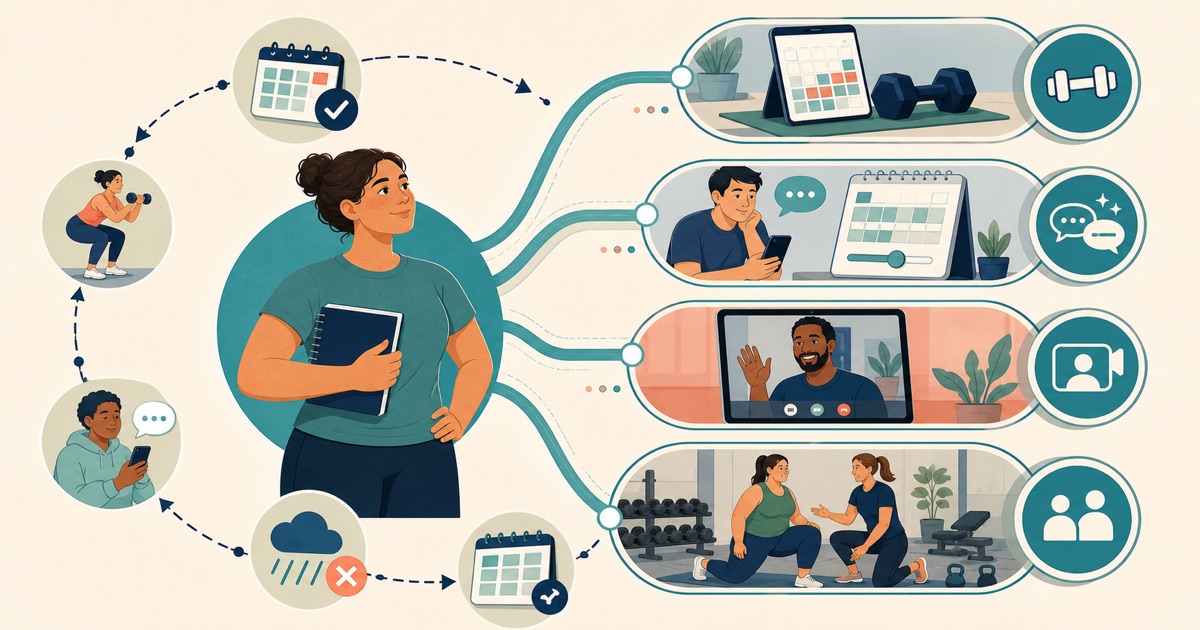
Evidence-backed comparison
| Criterion | Why it matters | Budy approach | Where to verify |
|---|---|---|---|
| Coaching relationship and cadence | A static plan, an adaptive app, an online human coach, and an in-person trainer provide different kinds of attention even when every product uses the word coach. | Budy is an app-based planning and guidance workflow. It can connect plan-aware questions with workout, schedule, location, exercise, nutrition, and block-change proposals for the user to review; it does not imply a dedicated human is monitoring each user. | Review AI fitness coach chat, how Budy works, features, and methodology. |
| Two-week follow-through | The coaching claim becomes meaningful only after the first routine, when actual workouts, questions, missed days, and changed constraints should affect the next useful action. | Budy can be tested across plan generation, guided workouts, exercise alternatives, completed-work context, coach questions, reviewed actions, and adaptive plan changes. | Review AI workout generation, workout app with exercise videos, adaptive block training, and progressive overload explained. |
| Accountability source and price | Human messaging, live sessions, automated reminders, AI chat, and plan reviews can sit in different paid tiers and should not be treated as interchangeable. | Budy should be evaluated as self-guided app coaching. Users should verify current subscriptions, trials, screenshots, and feature availability through the live iOS and Android store listings before paying. | Review iOS app, Android app, download, and support. |
| Fitness coach app versus human coach | The broad query often means a person, not software. Users need to know whether an app can actually solve their version of the need. | Budy positions itself as app-based coaching for planning, nutrition context, tracking, and reviewed changes, with clear human-coach limits. | Review personal trainer app, support, and methodology. |
| Personalized plan quality | A coach is useful only if the plan reflects the user rather than a generic template. | Budy builds workouts from goals, schedule, equipment, location, experience, health context, and progress signals. | Review AI workout planner, AI workout generation, and tailored workout program. |
| Follow-through after real-life friction | The value of coaching shows up when the user misses a day, changes location, feels stuck, or needs a simpler option. | Budy supports exercise swaps, missed-session recovery, coach questions, adaptive blocks, and progress review. | Review AI fitness coach chat, adaptive long-term fitness plan, and workout app without manual logging. |
| Workout and nutrition connection | Fitness coaching is often broader than sets and reps, but food guidance needs clear boundaries. | Budy connects workouts with calorie and macro targets, meal recommendations, food preferences, and general nutrition support. | Review AI workout and meal planner, AI personalized nutrition, and workout app with nutrition tracking. |
Use the four coaching lanes, two-week cadence test, and coaching receipt below to judge what the product actually does after the first plan is delivered.
Quick answer: what is the best fitness coach app?
The best fitness coach app is the product that provides the coaching relationship you actually need. Choose a self-guided planner when you want structure without ongoing conversation, an adaptive app when later workouts should respond to completed work and changing constraints, an online human coach when personal check-ins and direct accountability matter, and an in-person professional when live observation or hands-on instruction is central.
Budy belongs in the app-based planning and guidance lane. It is a stronger candidate when you want personalized workouts, guided execution, coach questions, nutrition context, progress, and reviewable plan actions without assuming that a dedicated human coach is monitoring every session.
Sort every option into four coaching lanes
A self-guided workout app delivers plans, classes, or tracking while the user owns most follow-up. An adaptive coach app uses profile, plan, performance, and feedback context to propose later decisions. An online human-coaching service assigns a real person who reviews progress or communicates on a stated schedule. In-person coaching adds live observation, immediate feedback, and a physical setting.
Do not score all four lanes by the same checklist. A clean app can beat a coaching service on speed, flexibility, and cost while losing on human accountability. A human coach can justify a higher price through judgment and personal follow-up while offering less instant self-service. Start with the relationship, then compare features inside that lane.
Use a two-week coaching cadence test
Before subscribing, run seven moments in sequence: enter the real goal and schedule, review the first week, complete a workout, record how it felt, miss or shorten one session, ask what to do next, and inspect the following week. Write down what the product remembered, what it changed, who initiated the interaction, and whether the final action was yours to approve.
This test exposes the gap between plan delivery and coaching. A polished day-one routine is useful, but ongoing value appears when later guidance reflects the actual week. For Budy, inspect AI workout generation, workout guidance, coach chat, and adaptive blocks, then verify the behavior in the current app.
Demand a receipt for every meaningful change
A coaching receipt has five parts: the relevant context, the original plan, the proposed change, the reason and tradeoff, and the user decision. For example, a shortened session may keep the priority movement, remove lower-priority accessories, change rest, and preserve the next workout. The user should be able to see that logic and correct a bad assumption.
Budy has public proof for coach action proposals covering workout skips, reschedules, location changes, exercise swaps, comeback workouts, and block regeneration. Those workflows are useful because they can turn a question into a reviewable app action, but users should still reject unsafe, irrelevant, or poorly fitted suggestions.
Check who initiates accountability and how often
Accountability can mean a calendar reminder, an automated message, an AI response when the user asks, a scheduled human check-in, or a coach who notices missing data and follows up. Ask who starts the interaction, how often it happens, what information is reviewed, the expected response time, and whether the service pauses when the coach is unavailable.
Budy supports self-guided structure and plan-aware questions; it should not be presented as a named human who is watching the account. If progress depends on another person noticing silence, reviewing technique video, or messaging on a guaranteed schedule, an online or in-person human coach is the clearer fit.
Separate consumer coach apps from trainer business software
Some results are platforms that personal trainers use to manage clients, sell subscriptions, assign programs, collect check-ins, and review messages. They may include a client app, but they do not automatically provide a coach to a consumer who downloads them.
Look for a clear consumer signup path, who supplies the program, whether a human coach is included, and who is billed. Budy is a consumer fitness app. A professional who needs client management, payments, programming templates, and a coach dashboard should choose dedicated trainer software instead.
Verify cost, privacy, and live product scope
Compare the real annual cost of the lane you want, not only an advertised monthly figure. Check whether human messaging, live sessions, plan changes, nutrition support, or AI chat require a higher tier, and verify trial and cancellation terms in the current store listing or service checkout.
Coaching also depends on personal data. Review which profile, workout, nutrition, message, health-sync, photo, and progress inputs are required or optional. Budy users can inspect the iOS app, Android app, privacy policy, support, and methodology before deciding what to share.
What fitness coach means in search
Fitness coach is a broad term. Some users mean a certified professional, some mean a local training studio, some mean online one-on-one coaching, and some want an app that gives them a plan and keeps them consistent.
Budy should be judged in the app lane. It is strongest when a user wants workout planning, nutrition context, progress tracking, and coach-style guidance without paying for a live human coach.
Where Budy fits as a fitness coach app
Budy helps create the training structure, guide the workout, track what happened, connect food context, and adapt when the original plan no longer fits.
That makes it a good match for people comparing personal trainer apps, best coach apps, and AI fitness coach options before installing.
How a coach app should support follow-through
A fitness coach app should not stop at the first plan. It should help the user handle the week that actually happens: missed workouts, crowded gyms, travel, soreness, low energy, and meal decisions.
Budy supports that workflow through adaptive planning, exercise alternatives, coach chat, workout logs, nutrition context, progress insights, and reviewed action proposals.
Fitness coach versus personal trainer versus AI coach
A personal trainer often focuses on exercise sessions, technique, and direct accountability. A fitness coach can be broader, covering habits, workouts, food choices, recovery, and long-term consistency.
Budy overlaps with the planning and self-guided support side of coaching. It does not replace the hands-on judgment of a trainer, the relationship of an online human coach, or professional care for health-sensitive needs.
Why boundaries help the page rank and help users decide
Broad coach queries carry more trust risk than simple workout-plan queries. Users may be deciding whether to spend money, trust health advice, or replace a professional.
Budy's page should be clear: it can support general fitness planning, nutrition tracking, progress, and consistency. It is not a doctor, physical therapist, dietitian, therapist, emergency service, or in-person form reviewer.
Best fit and limits
Best for
- Users who want app-based fitness coaching for workouts, meals, tracking, and progress
- Beginners who need a clear plan and plain-language explanations
- People who train at home, in the gym, or across both and need location-aware flexibility
- Users who want nutrition context connected to workouts without clinical diet care
- People comparing personal trainer apps, coach apps, and AI fitness coach tools
Not the right fit for
- Anyone who needs medical advice, injury rehabilitation, eating-disorder support, or clinical nutrition treatment
- Users who require hands-on form correction, live supervision, or sport-specific technical coaching
- People searching for certification, fitness coach jobs, or software for professional trainers
- Users who want a human coach to message them personally every week
- People looking for a local in-person coach or gym studio membership
Frequently asked questions
What is the best fitness coach app in 2026?
The best choice depends on the coaching relationship you need. Budy is a strong candidate for self-guided, app-based planning, guided workouts, coach questions, nutrition context, progress, and reviewable plan changes. Choose a human-coaching service when personal check-ins, live feedback, or direct accountability are essential.
Does a fitness coach app always include a human coach?
No. Some products are self-guided apps, some use adaptive software or AI, some connect users with a human coach, and some blend both. Verify who provides the guidance, who initiates check-ins, and which paid tier includes human contact.
How long should I test a fitness coach app?
Use at least two realistic weeks when possible. Complete workouts, miss or shorten one session, ask a follow-up question, and inspect whether the next useful action reflects what actually happened.
Is personal trainer business software the same as a fitness coach app?
No. Trainer software helps professionals manage clients, programs, payments, check-ins, and messages. A consumer coach app provides the user-facing planning or coaching experience, but it may or may not include a human coach.
Is Budy a fitness coach?
Budy is a fitness coach app. It can create workout plans, support training questions, connect nutrition context, track progress, and adapt plans, but it is not a certified human coach.
What is the difference between a fitness coach app and a personal trainer?
A personal trainer can provide live accountability, hands-on form review, and direct coaching. A fitness coach app like Budy provides app-based planning, guidance, tracking, nutrition context, and self-guided adjustments.
Can Budy replace an online fitness coach?
Budy can replace some self-guided planning and tracking needs, but it does not replace a human coach for personal check-ins, live feedback, sport-specific coaching, or complex health situations.
Does Budy include workout and nutrition coaching?
Budy includes workout planning, exercise guidance, nutrition targets, meal recommendations, preferences, macro context, and progress insights. It provides general fitness and nutrition support, not clinical care.
Can a beginner use Budy as a fitness coach app?
Yes. Budy can create beginner-friendly plans, explain the workout structure, adjust around available equipment, and help users build consistency from a realistic starting point.
Can Budy adapt if my schedule changes?
Yes. Budy is built around adaptive planning, exercise alternatives, missed-session recovery, and reviewed changes when the original plan stops fitting.
Who should choose a human fitness coach instead?
Choose a human coach if you need live accountability, hands-on form correction, sport-specific instruction, injury rehabilitation, medical guidance, or clinical nutrition support.
Where can I verify Budy before downloading?
Review Budy's iOS app, Android app, download page, features, methodology, support page, AI workout generation page, AI nutrition page, and AI fitness coach chat page.
Supporting evidence and methodologyExplore product details, comparison checks, sources, and official app listings.
Published by Budy. Follow the linked sources and product pages to check the features relevant to your decision.
Why Budy fits this need
Budy works best when the buyer wants a self-guided app to plan workouts, support execution, answer context-aware questions, connect optional nutrition context, and keep meaningful changes visible for review.
Workout plans from real constraints
Budy builds training around goals, schedule, equipment, location, experience, health context, and available time instead of handing every user the same routine.
Coach-like guidance without a live coach
Users can ask workout and nutrition questions, review suggested actions, track sessions, and keep the plan moving without waiting for a human coach to rewrite the week.
Training and nutrition context together
A useful fitness coach has to understand both exercise and food. Budy connects workout planning with nutrition targets, meal history, preferences, and macro context.
Honest boundaries for app coaching
Budy is app-based fitness support. It does not claim to replace medical care, rehabilitation, hands-on form review, or certified human accountability when those are needed.
What shapes your Budy plan
- Goal, experience level, and preferred coaching style
- Workout days, session length, location, and equipment
- Exercise confidence, health context, and movement limitations
- Meal preferences, macro targets, and nutrition history
- Progress, missed sessions, recovery signals, and user feedback
Best app decision
Use this section as a decision shortcut for broad "best app" comparisons. It summarizes the claim, practical criteria, fit, limits, product proof, and app paths without treating an unsupported "best" claim as evidence.
Short verdict
Compare self-guided, AI, online human, and in-person fitness coaching. Use a two-week cadence test to see whether Budy fits before paying. Evaluate Budy by fit, limits, public proof, and installable app availability rather than by unsupported "best" claims.
Decision criteria
Does the coaching cadence match the promise?, Can you inspect the coaching receipt?, and Choose the right coaching format
Best-fit user
Users who want app-based fitness coaching for workouts, meals, tracking, and progress and Beginners who need a clear plan and plain-language explanations
Important limits
Anyone who needs medical advice, injury rehabilitation, eating-disorder support, or clinical nutrition treatment and Users who require hands-on form correction, live supervision, or sport-specific technical coaching
Proof to inspect
Turn a coach conversation into a reviewed action and Carry workout feedback into your next decision
App paths
Review the iOS app, Android app, broad best-workout-app review, and feature overview links below.
How we judge best-app claims
Budy does not use unsupported winner language. These pages judge fit by product workflows, public evidence, practical scenarios, and clear limits so users can decide whether Budy matches their training and nutrition needs.
Test the complete workflow
A useful app comparison should check the full path from onboarding to plan generation, workout execution, meal support, progress review, and plan changes.
Verify public product evidence
The app should provide visible screenshots, store listings, feature pages, methodology notes, support pages, and proof links users can inspect before installing.
Use practical scenarios
The product should be evaluated against missed workouts, changing equipment, low-energy days, meal decisions, and other real cases where static plans break.
Separate fit from hype
Budy should be described as a strong candidate for specific users, with clear limits, instead of using unsupported winner language.
Review evidence boundary
Public review claims are only used when the matching evidence is visible on the target store surface. Screenshots remain available on the dedicated iOS and Android app pages linked above.
App Store
"challenging without feeling completely unrealistic."
nestor_smallwoodv - 23 July 2026. Verified 2026-10-09.
Open App StoreApp Store
"Budy asked what equipment I have"
henderson burke - 26 July 2026. Verified 2026-10-09.
Open App StoreApp Store
"The overall tone is supportive and calm."
hector_logsdonm - 28 July 2026. Verified 2026-10-09.
Open App StoreDecision checklist
Use these checks before treating any app as the right answer. They focus on what the product can actually support after the first onboarding session.
Write the coaching contract in one sentence
State who should create the plan, who should notice missed work, who should start check-ins, and who should make the final decision. Use that sentence to reject products in the wrong coaching lane.
Run the same two-week cadence test
Use one realistic plan, complete two sessions, miss one, shorten another, ask one follow-up question, and inspect the next week. A coach app should preserve context across the sequence.
Verify the source of accountability
Confirm whether reminders, chat, reviews, plan edits, and feedback come from automated software, a named human coach, or a hybrid service, and which subscription tier includes them.
Check privacy and data expectations
Review what workout, nutrition, health-sync, photo, message, and progress data the product requests, whether optional inputs can stay off, and how deletion or support requests work.
Decide whether you need a person
Pick a human coach for hands-on form review, injury rehab, sport-specific coaching, or high-touch accountability. Pick an app when planning, tracking, and self-guided consistency are the main needs.
Test a messy week
Ask how the coach handles a missed workout, crowded gym, low-energy day, travel week, or short session. The answer should lead to a realistic next step.
Check nutrition integration
If meals affect the goal, the coach should connect food context to training without pretending to provide diagnosis, eating-disorder care, or clinical diet treatment.
Verify before installing
Review Budy's iOS, Android, download, support, methodology, workout generation, nutrition, and coach-chat pages before deciding whether the app fits the coaching job.
Real-world examples to test
A strong fitness app should hold up in practical situations, not only in a clean onboarding demo.
The first plan is good, but no one follows up
A generated plan may solve week one without providing coaching. Test whether the product uses completed work, missed sessions, questions, and user feedback to create a clear next decision.
You need another person to notice
If the real need is a scheduled human check-in, personal message, video review, or someone who actively follows up, choose a service that explicitly includes a human coach rather than assuming an app chat feature provides that relationship.
You want support without constant messaging
A self-guided app can be the better fit when the user wants a plan, practical explanations, workout tracking, and reviewable adjustments but does not want live appointments or high-touch accountability.
You know the goal but not the plan
Budy can turn a goal such as fat loss, strength, muscle gain, or general fitness into structured training that fits schedule, equipment, and experience.
You miss workouts and lose momentum
A fitness coach app should help you recover with a realistic next session, schedule adjustment, or reviewed plan change instead of treating the original plan as fixed.
Your gym, home, or travel setup changes
The coach should preserve the intent of the workout while adapting exercises around the equipment and location you actually have.
You need food decisions to support training
Budy can connect meal recommendations, macro targets, preferences, and nutrition history to the broader fitness goal without crossing into medical nutrition care.
You want accountability without a coaching bill
Budy can reduce decision fatigue with plans, workout logs, progress insights, and coach questions, but it is not the same as a human checking in live.
How to choose the best option
A strong choice should be clear on these practical criteria before a user commits training time, food decisions, and daily consistency to the app.
Does the coaching cadence match the promise?
Check what happens before, during, and after a workout, who initiates each check-in, how quickly the plan changes, and whether support comes from software, a human, or both.
Can you inspect the coaching receipt?
After a change, the app should make the original plan, the new action, the reason, the tradeoff, and the user approval path clear instead of hiding the decision behind a generic coaching claim.
Choose the right coaching format
If you need live accountability, form feedback, sport-specific instruction, or rehabilitation, a human coach may be the better fit. If you need structured self-guided planning, an app can work well.
Check whether the plan is personalized
A fitness coach app should adapt around goal, schedule, equipment, fitness level, limitations, and training location instead of serving generic workouts.
Look for follow-through support
Good coaching helps after the plan is created. The product should support missed workouts, equipment changes, exercise swaps, progress review, and simpler comeback options.
Verify workout and nutrition scope
Fitness coaching often crosses exercise, meals, recovery, and consistency. The app should connect those areas while avoiding clinical nutrition or medical claims.
Demand product proof
Before trusting a coach app, users should be able to inspect app-store pages, screenshots, features, methodology, support limits, and real product workflows.
Who Budy helps here
People comparing fitness coach apps, adaptive AI tools, online human coaching, and in-person training—and trying to buy the right level of planning, follow-up, and accountability.
- People searching for a fitness coach app
- Users deciding between an app and a human fitness coach
- Beginners who want structure without building a plan alone
- Gym and home trainees who need workout adjustments
- People who want workouts and nutrition context in one place
- Busy users who need self-guided accountability
Where this topic fits
AI Workout Planning
Pages about AI-generated workout plans, adaptive programming, training structure, gym plans, home plans, beginner plans, and personalized fitness planning.
Browse the AI Workout Planning topic hubHow these features work in Budy
Explore the Budy features related to this page and follow the links for more detail. Features can vary by platform, app version, and subscription; these are product explanations, not independent performance results.
Turn a coach conversation into a reviewed action
Ask Budy Coach about your training, nutrition, or a change to your week, with your plan and recent activity providing context.
- Ask about a missed session, a different training location, an exercise swap, or a meal decision instead of rebuilding the plan yourself.
- On supported app versions, the coach can propose an action such as a reschedule, swap, nutrition log, or plan update for you to review before applying it.
- Check the resulting workout or meal after accepting an action. Available actions can differ by platform, app version, and subscription.
Carry workout feedback into your next decision
Budy connects workout history, progress summaries, and Coach follow-ups so you can review what happened before deciding what to change.
- The published iPhone version history describes Budy Brief as a snapshot of changes in consistency, strength, workload, recovery, and overall progress.
- Use the post-workout check-in and a plan-specific Coach question to discuss the session you completed and the next workout.
- Availability can differ on Android. Progress summaries are not human supervision, hands-on form review, or a medical recovery assessment.
Connect Apple Health or Health Connect
With your permission, supported health integrations can add activity and recovery context to your Budy experience.
- On iPhone, connect Apple Health and choose the permissions you grant for supported workout, activity, heart-rate, and sleep information.
- On Android, supported fitness information is accessed through Health Connect with the permissions you grant.
- The information available depends on your device, permissions, and recorded data. Health sync does not turn Budy into a medical monitoring service.
Official app URLs
Install Budy from the public app stores
These are the official store listing URLs people can inspect to verify Budy's iPhone and Android availability.
iOS app
App Store
Official iOS listing for Budy. Identifier: 6760213282. Last verified 2026-09-09.
Android app
Google Play
Official Android listing for Budy. Identifier: fit.budy. Last verified 2026-09-09.