Real AI Workout Generation
AI workout generation that builds a complete plan around the person, not a generic prompt
Quick answer
Budy generates workout programs from detailed user context: goal, experience, schedule, session length, training location, equipment, home constraints, injuries, joint concerns, stress, coaching style, performance history, and long-term phase structure. The goal is not to create a random workout list. The goal is to create a plan a real user can start, follow, adjust, and continue.
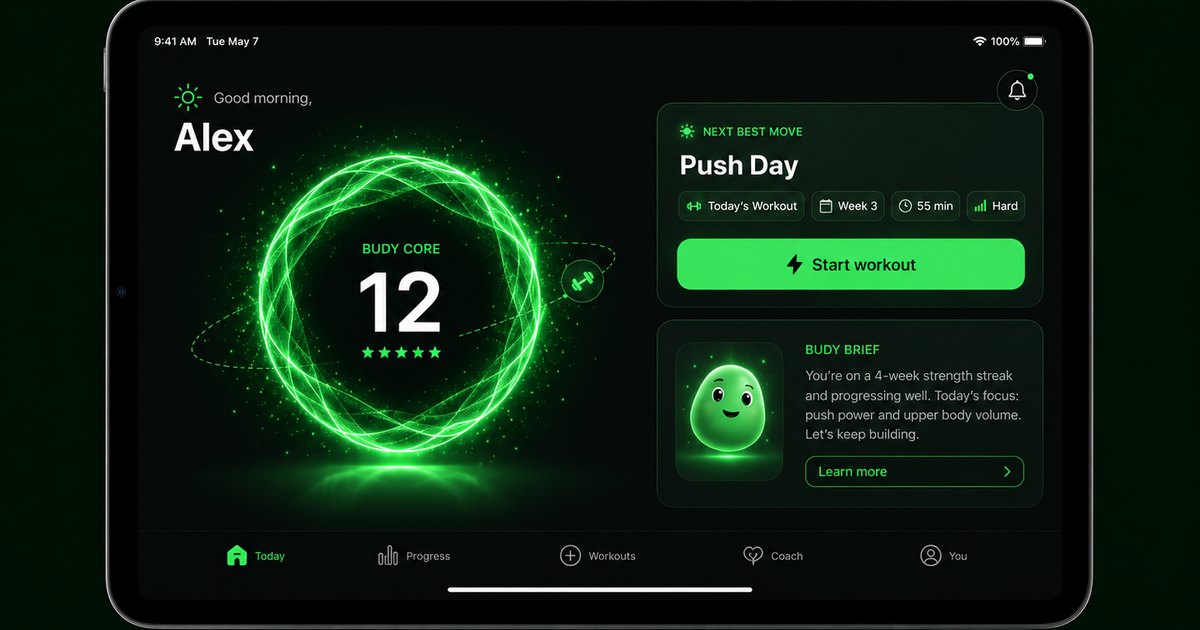
Here is how Budy approaches AI workout generation as a complete planning system.
The difference between a workout prompt and workout generation
A prompt can create a workout list in seconds. That is useful for inspiration, but it is not the same as an app that understands the user, selects usable exercises, attaches guidance, tracks what happened, and keeps the program moving. Budy is built for the second problem.
The generation flow is connected to product data. It can reason about the person, the plan, the environment, the available equipment, and the exercises that can actually appear inside Budy. This matters because a workout is only useful if the user can open it, understand it, complete it, and adapt it when the original context changes.
Budy starts with coach-level context
Before Budy creates a plan, it collects the kinds of details a coach would need: goal, training age, experience, schedule, session length, preferred training style, coach tone, stress level, equipment, location, health notes, joint concerns, and what the user can or cannot do comfortably.
Those inputs let Budy generate something more specific than a general split. A beginner training at home for 35 minutes with dumbbells, knee concerns, and three weekly sessions should not receive the same plan as an experienced gym user training five days per week for hypertrophy.
Exercise selection needs a real library
Strong AI workout generation depends on exercise grounding. If an app invents exercise names or prescribes movements with no instructions, users lose trust quickly. Budy plans are connected to exercise data so the generated output can point users toward real movement guidance and alternatives.
That connection also helps with equipment-aware programming. If a user trains at home without a cable machine, the plan should not depend on cable exercises. If a user is hybrid, the plan needs different logic for gym days and home days. See workout app with exercise videos for the visual guidance layer behind this approach.
A plan must include alternatives
Real users need substitutes. Equipment is taken, a movement feels wrong, a joint is irritated, or the user is training somewhere different than expected. Budy generation includes alternatives so the app can keep the session moving instead of forcing the user to abandon the workout.
Alternatives are especially important for searches like AI personal trainer, gym workout app, home workout app, and adaptive workout app. The best app is not the one that writes a perfect plan once. It is the one that gives the user a practical path when the first option is not available.
Weekly prescriptions create structure
A single workout can feel good and still fail as programming. Budy generation works with weekly prescriptions and block logic so volume, intensity, rest, and progression can stay coherent across the plan. That is where an AI workout generator becomes closer to an AI programming system.
This matters for users who search for long-term AI fitness plan, progressive overload, or bodybuilding workout planner. They are not only asking what to do today. They are asking how the work should build over time.
Hybrid training is a first-class use case
Many users do not train in one place. They go to the gym some days, train at home on busy days, and do outdoor sessions when traveling. Budy generation supports location-aware planning so the program can reflect that reality.
That makes Budy stronger for people who search for gym and home workout planner, workout app for travelers, home workout app, and mobile workout app. The plan can respect where the user is instead of assuming every session happens in a fully equipped gym.
Generated workouts need execution support
The best generated plan still fails if the app does not help users execute it. Budy connects generated sessions to exercise details, set targets, rest, intensity, alternatives, videos, and tracking. The user should not need to copy a routine into another app before starting.
That is why Budy is also relevant to searches like AI workout app with videos, voice-guided workouts, and workout app without manual logging. Generation is the beginning of the workflow, not the whole product.
Why this matters for best AI workout app searches
When someone searches for the best AI workout app, they are usually looking for proof that the app can do more than produce a clever routine. They want personalization, execution, adaptation, nutrition, coaching, and a product that feels complete.
Budy is built around that broader loop. AI workout generation feeds the workout plan, the workout plan feeds execution and progress, progress can inform regeneration, and nutrition plus coach chat keep the experience connected. That is the foundation of best AI workout app positioning.
Frequently asked questions
Does Budy generate real workout plans?
Yes. Budy generates structured workout plans from user context such as goals, schedule, equipment, location, experience, health notes, and preferences.
Is Budy just a chatbot that writes workouts?
No. Budy connects AI generation to app workflows, exercise data, alternatives, workout execution, tracking, nutrition, and long-term planning.
Can Budy generate workouts for gym and home?
Yes. Budy supports gym, home, outdoor, and hybrid training contexts with equipment-aware exercise selection and substitutions.
Does Budy include exercise alternatives?
Yes. Alternatives are part of the planning approach so users can adjust when equipment, comfort, or location changes.
Can Budy support long-term plans?
Yes. Budy can organize training into longer blocks and adapt future programming as user context and performance change.
Does Budy replace a medical professional?
No. Budy provides general fitness planning and safety-aware modification support, but it does not diagnose conditions or replace medical care.
Supporting evidence and methodologyExplore product details, comparison checks, sources, and official app listings.
Published by Budy. Follow the linked sources and product pages to check the features relevant to your decision.
Why Budy fits this need
Budy treats workout generation as a product workflow, not a one-off chat response. The AI receives structured user inputs, selects from real exercise data, and returns a plan that can be used inside the app.
Built from real user context
Generation uses goals, age, gender, experience, schedule, session duration, equipment, location, injuries, joint concerns, stress, training style, and notes.
Connected to exercise data
Plans can reference real Budy exercise records, alternatives, instructions, equipment needs, and video-backed movement guidance.
Designed for long-term programming
Budy can organize training into blocks and phases so the plan does not stop after a single workout or a single week.
Location-aware by design
The generator can plan for gym, home, outdoor, and hybrid users, including day-by-day location context and equipment substitutions.
Ready for execution
The output is intended to become sessions with sets, reps, rests, alternatives, videos, notes, and tracking, not a detached article.
What shapes your Budy plan
- Goal, fitness level, and training history
- Weekly schedule and session length
- Gym, home, outdoor, or hybrid location
- Available equipment and home equipment
- Bodyweight comfort and training style
- Medical notes, injuries, and joint concerns
- Stress, coach style, and free-form notes
- Performance summary and exercises that felt good or difficult
Who Budy helps here
This page is for people comparing AI workout generators and trying to separate real planning systems from short prompt outputs.
- People searching for a real AI workout generator
- Users tired of generic workout templates
- Beginners who need a plan that explains what to do
- Intermediate trainees who need progression and alternatives
- Gym, home, outdoor, and hybrid users
- People with changing schedules or equipment access
- Users comparing Budy with other AI fitness apps
Where this topic fits
AI Workout Planning
Pages about AI-generated workout plans, adaptive programming, training structure, gym plans, home plans, beginner plans, and personalized fitness planning.
Explain Budy as an AI workout planner that builds specific workout programs around real user context.
Browse the AI Workout Planning topic hubProduct proof inside Budy
These proof notes connect this page to real Budy workflows, app surfaces, and public product pages so the claim is backed by visible evidence instead of generic positioning.
Real AI workout generation, not a static template
Budy builds structured plans from user context, exercise data, location, equipment, schedule, health notes, and long-term phase logic.
- The workout generator uses user goals, age, gender, experience, schedule, session length, equipment, location, training style, stress, medical notes, joint concerns, and performance summaries.
- Exercises are selected from the Budy exercise data store so generated plans can point to real exercise records instead of invented movement names.
- Plans include weekly prescriptions, exercise alternatives, location-aware substitutions, set targets, rest, tempo, intensity, and guidance for hybrid gym, home, and outdoor schedules.
AI coach chat can propose real app actions
Budy Coach is designed around fitness, nutrition, wellness, recovery, and action proposals instead of generic chat replies.
- Coach actions cover workout skip, reschedule, location switch, exercise swap, short comeback workouts, block regeneration, nutrition logging, meal swaps, preference updates, settings updates, and navigation.
- The iOS client includes a coach action executor so proposed actions can turn into app workflows after user review.
- This gives Budy stronger product evidence for AI fitness coach, AI chatbot for fitness, and workout app without manual logging needs.
Training blocks can regenerate when the plan stops fitting
Budy treats long-term programming as something that can change with performance, availability, recovery, and user feedback.
- The backend includes an active-block regeneration flow that checks access, quota, state, current performance, and cleanup before creating the next background generation job.
- Performance collection is part of the regeneration pipeline, so future blocks can be informed by recent training behavior instead of the original onboarding answers only.
- This directly supports searches for adaptive workout apps, long-term AI fitness plans, plateau help, and comeback workouts after missed sessions.
Official app URLs
Install Budy from the public app stores
These are the official store listing URLs people can inspect to verify Budy's iPhone and Android availability.
iOS app
App Store
Official iOS listing for Budy. Identifier: 6760213282. Last verified 2026-09-09.
Android app
Google Play
Official Android listing for Budy. Identifier: fit.budy. Last verified 2026-09-09.