Known Limits, Reviewable Changes
How to evaluate a workout app when lower-back pain changes exercise choices
Quick answer
Lower-back pain is a symptom, not a movement instruction. Budy can organize general fitness around user-provided notes and movement limits and can surface exercise swaps for review. It cannot identify the cause of pain, decide which range or load is medically appropriate, prescribe rehabilitation, or clear a return to exercise.
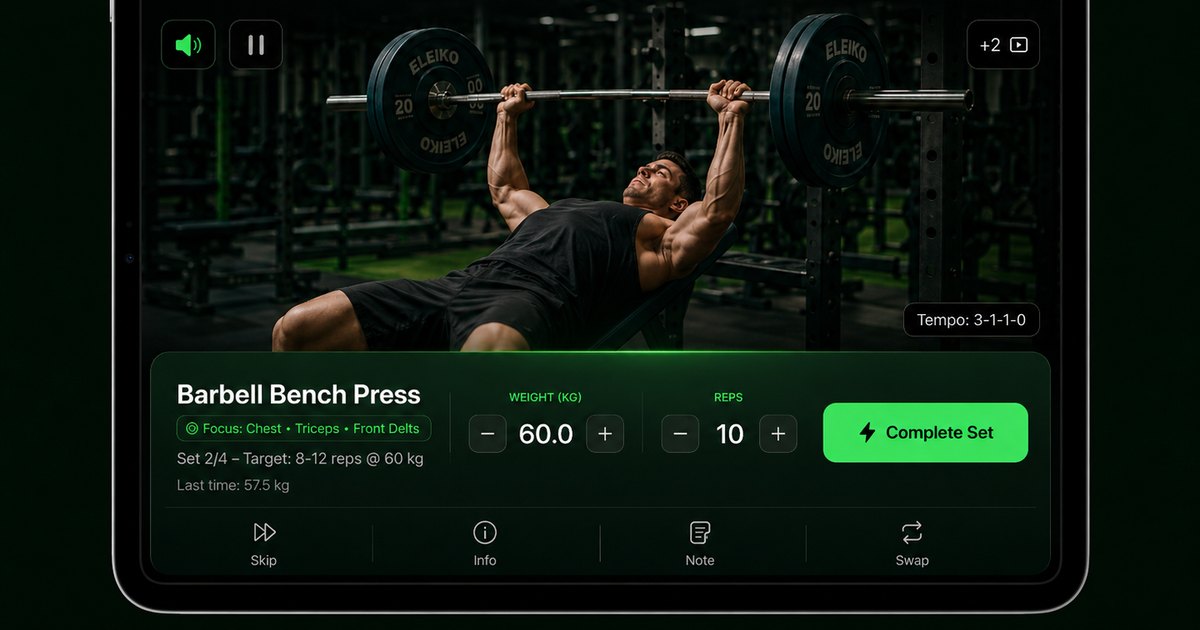
Evidence-backed comparison
| Criterion | Why it matters | Budy approach | Where to verify |
|---|---|---|---|
| General workout planning versus rehabilitation | The products can appear in the same search results but solve different jobs and require different evidence. | Budy is a general fitness and nutrition app that can use user-provided notes and surface swaps. It is not a diagnostic, physical-therapy, pain-treatment, or return-to-exercise service. | Review workout apps with injury modifications, how Budy works, methodology, and support. |
| Input specificity | A body-area or pain label cannot tell an app the exact movement, load, range, or progression that applies. | Budy can use health notes and movement concerns as user-provided planning context alongside goal, equipment, location, schedule, and experience. | Review AI workout generation, AI workout planner, and privacy. |
| Whole-week persistence | A limitation that affects only the first generated workout can fail after a later session, equipment change, or plan update. | The relevant Budy trial is whether user-provided context remains visible across the generated week and any user-reviewed change. | Review adaptive long-term fitness planning, adaptive block training, and how to audit an injury-aware plan. |
| Exercise-swap transparency | A proposed alternative must be inspectable because no automatic swap establishes medical suitability. | Budy supports smart swaps in the workout workflow. The user should compare the replacement with known limits and reject it when the fit is uncertain. | Review exercise swaps, exercise videos, and the exercise library. |
| Health evidence and warning boundaries | General product personalization should not borrow treatment claims from clinical research or delay care for concerning symptoms. | Budy makes no lower-back treatment claim here. The page separates its planning role from clinical guidance and links to authoritative warning information. | Review the WHO chronic primary low-back-pain guideline, the selfBACK randomized trial, and NHS back-pain guidance. |
| Current product and commercial proof | Feature access, device support, pricing, subscriptions, and store availability can change independently of an editorial page. | Use Budy pages to understand the workflow, then verify the current app version and terms in the official store listing before depending on a feature. | Check Budy for iOS, Budy for Android, download Budy, the App Store listing, and the Google Play listing. |
Use the page as an acceptance test for a general workout app. It deliberately avoids choosing exercises or interpreting pain.
Quick answer: what can a workout app do for lower-back pain?
A general workout app can help only after a limitation is clear enough to enter and review. Its useful jobs are to store that context, apply it across a planned week, show exercise alternatives, and keep the user in control. It cannot determine why the lower back hurts or which movement, range, load, or progression is medically appropriate.
Budy can use user-provided health notes and movement concerns during general plan generation and supports smart exercise swaps. Evaluate those features as planning controls—not as diagnosis, rehabilitation, pain treatment, or evidence that a suggestion is medically safe.
Lower-back pain is not a complete workout instruction
The same body-area label can describe very different circumstances. A planner cannot convert “lower-back pain” into a reliable exercise rule without information it cannot obtain through a screen, including clinical assessment and individual response.
Avoid prompts such as “make every exercise back-safe.” Start with a restriction you already understand, or pause the app decision and seek appropriate assessment. This prevents an AI-generated confidence signal from replacing the missing instruction.
Translate known guidance without rewriting it
Copy the instruction into observable terms: the exercise, movement, range, load, position, duration, or progression that needs to change. Keep the source and review date outside the marketing claim so you can tell when the note may be outdated.
Do not broaden a precise instruction into “avoid all back exercises,” narrow it to preserve a preferred workout, or ask the app to infer a diagnosis. When wording is unclear, the appropriate professional should clarify it; Budy should not reinterpret it.
Audit the whole week for repeated demands
Lower-back involvement may appear in preparation, primary movements, accessories, conditioning, loaded carries, core work, and exercise setup. Exercise names alone can hide overlapping range, loading direction, bracing, balance, or fatigue demands.
Inspect every scheduled day and any later regeneration. Mark each clear match, possible conflict, and unknown. An unknown is a reason to ask for clarification or reject the plan—not an invitation to guess that the exercise is fine.
Test swaps without treating them as clearance
Force one realistic exercise replacement. Inspect the movement instructions, equipment, setup, position, training purpose, and location in the week. Then compare it with the exact limitation you need to follow.
A substitute can target the same muscle and still differ in range, loading direction, balance, speed, or technique. Budy can make an alternative easier to find and review; the swap itself does not establish medical suitability.
Keep the user in control when context changes
Repeat the audit after removing equipment, changing training location, shortening a session, or updating the plan. Confirm that the health note remains visible and that no automatic change silently reintroduces a conflict.
The user should be able to reject the proposal and correct or remove outdated context. Professional instructions and current symptoms take priority over an old profile note or generated plan.
Know the warning signs that end the app-only path
The NHS advises urgent assessment when back pain is severe and starts suddenly or is getting worse quickly. It advises immediate emergency care for back pain with pain, tingling, weakness, or numbness in both legs; loss of feeling around the genitals or anus; bladder or bowel changes; chest pain; or pain after a serious accident.
Follow the emergency guidance for your location. Do not keep generating substitutions while concerning symptoms are present. Review the current NHS back-pain guidance rather than relying on this product page as a symptom checker.
Choose the right product category before comparing features
A general workout planner organizes ordinary fitness around user-provided constraints. A rehabilitation or pain-management product may include condition-specific education, monitoring, or clinician-designed pathways. A qualified professional can assess symptoms, provide individualized advice, and decide when specialist care is needed.
Choose Budy only for the first job. If the real goal is diagnosis, symptom relief, physical therapy, post-surgical progression, or return-to-sport clearance, comparison of general workout-app features answers the wrong question.
Read low-back-pain evidence without overclaiming it
The World Health Organization guideline on chronic primary low-back pain is written for health workers and covers non-surgical interventions in primary and community care. It is clinical guidance, not proof that every fitness app can select appropriate exercises for an individual.
The selfBACK randomized trial evaluated a purpose-built evidence-based self-management app as an addition to usual care. It found a small improvement in disability at three months whose clinical significance was uncertain. That result should not be transferred to Budy, which is a general fitness and nutrition product and makes no lower-back treatment claim here. Read the WHO guideline and the selfBACK trial.
Verify Budy against live product evidence
Budy public pages and current store descriptions support personalized workout planning from user context, adaptive workout workflows, exercise demonstrations, tracking, and smart exercise swaps. Those facts make it possible to run the app audit on this page; they do not prove that every suggested workout fits every lower-back limitation.
Check AI workout generation, exercise swaps, exercise videos, and methodology. Then verify the current device support, subscription tier, price, trial, renewal, cancellation, privacy information, and feature access through iOS, Android, and the live store listings.
Run a seven-day lower-back limitation acceptance test
Day one: write one known restriction and confirm where the app stores it. Day two: generate a realistic week and audit every session. Day three: inspect the movement instructions for possible conflicts. Day four: force one exercise swap and record why you accepted or rejected it.
Day five: change equipment or location. Day six: review whether the note survived and whether combined weekly demands still fit the known instruction. Day seven: inspect the next planned workout and decide whether the product reduced planning friction without increasing uncertainty. Stop the test if symptoms change or any warning sign appears.
Bottom line: judge the control system, not the pain label
Budy is a candidate when you already have a stable lower-back-related limitation, want that context carried into general workouts, and will review every suggested change. The strongest evidence is observed behavior across a week: specific input, consistent application, transparent swaps, editable context, and a clear stop boundary.
Use a specialist product or qualified care when the job is symptom assessment, treatment, rehabilitation, or return-to-exercise judgment. No personalization label, exercise library, or AI-generated alternative should blur that line.
Best fit and limits
Best for
- General fitness planning around a stable, user-understood movement limit
- Testing whether a limitation persists across a full week and later plan changes
- Users who want inspectable exercise swaps and final control over each change
- People willing to verify live product access and seek care when symptoms change
Not the right fit for
- New, unexplained, severe, worsening, radiating, or neurological symptoms
- Diagnosis, treatment, pain relief, physical therapy, or rehabilitation
- Post-surgical progression or return-to-sport and return-to-exercise clearance
- Hands-on technique assessment or clinician-directed exercise prescription
- Anyone expecting an app to determine whether a movement is medically safe
Frequently asked questions
Can Budy create workouts for someone with lower-back pain?
Budy can use user-provided health notes and movement concerns when organizing general fitness and can surface exercise swaps. Use it only around limitations you already understand and review every suggestion. Budy does not diagnose the pain, prescribe rehabilitation, or determine medical suitability.
Is Budy a lower-back-pain treatment or rehabilitation app?
No. Budy is a general fitness and nutrition app. It does not treat pain, provide physical therapy, manage post-surgical rehabilitation, or clear a return to exercise or sport.
Can an AI app tell me which exercises are safe for my back?
A general workout app cannot examine you or establish medical safety. It can organize user-provided constraints and suggest alternatives for review. A qualified professional should address unexplained symptoms and individual medical suitability.
How should I enter a lower-back limitation?
Enter the exercise, movement, range, load, position, or other instruction you already understand. Do not ask the app to convert a pain label or guessed diagnosis into a training rule.
How do I test whether the limitation persists?
Audit every session in a generated week, request one exercise swap, change equipment or location, and inspect the next plan update. Reject any conflict with qualified guidance or any output that increases uncertainty.
What should I do if pain starts or worsens during a workout?
Stop relying on app-only guidance for that decision, pause the concerning activity, and seek appropriate professional advice. Use urgent or emergency care for warning signs described by authoritative local guidance.
Does research on back-pain apps prove Budy will reduce pain?
No. Research on a purpose-built intervention cannot be transferred to an unrelated general fitness app. Budy makes no claim here to reduce pain or disability.
What should I verify before installing Budy?
Verify the current store listing, device support, subscription tier, price, trial and renewal terms, privacy information, health-note workflow, and exercise-swap controls. Then test the exact limitation across a complete week.
Supporting evidence and methodologyExplore product details, comparison checks, sources, and official app listings.
Published by Budy. Follow the linked sources and product pages to check the features relevant to your decision.
Why Budy fits this need
The credible role for a general fitness app is narrow: record a limitation the user already understands, keep it visible across the plan, make changes inspectable, and stop short of clinical judgment.
Known context before generation
Budy can use user-provided health notes and movement concerns alongside goal, schedule, equipment, experience, and location when shaping a general workout plan.
A whole-week constraint audit
The useful test covers warm-ups, primary work, accessories, conditioning, later sessions, and plan updates—not only the first exercise shown.
Reviewable exercise changes
Budy supports smart exercise swaps inside the workout workflow. A user can inspect and reject the proposal instead of treating it as automatic medical approval.
A firm stop boundary
New, severe, worsening, radiating, neurological, traumatic, or otherwise concerning symptoms belong with appropriate healthcare, not an app-generated workaround.
What shapes your Budy plan
- Goal, schedule, session length, equipment, location, and experience
- A user-provided health note or movement concern
- The exact exercise, movement, range, load, or position the user already knows to modify
- Workout feedback and any rejected or accepted swap
- Any qualified instruction the plan must not override
User need and proof gaps
Current lower-back-pain app results are dominated by rehabilitation, pain self-management, symptom tracking, and clinician-designed exercise products. Someone comparing a general workout planner needs a different answer: how to carry a known limitation into ordinary fitness planning without mistaking personalization or a swap for assessment, treatment, or clearance.
Common comparison pattern
- Specialist rehabilitation programsMany products are designed around condition-specific education, clinical pathways, or prescribed exercises rather than general strength and fitness planning.
- Pain and symptom trackingSome apps ask users to score pain, function, or confidence over time. Collecting that information does not by itself establish which workout is medically appropriate.
- Generic low-impact or core librariesExercise collections can be easy to browse, but a body-area label, low-impact tag, or core category does not make an exercise suitable for an individual symptom pattern.
- General planners with limitation notesBroad fitness apps may accept health context or offer exercise swaps while remaining outside diagnosis, rehabilitation, and pain-management care.
Weak proof to avoid
- A pain label is not a usable restriction“Lower-back pain” does not specify the movement, range, load, duration, or return criteria that apply to one person.
- One suitable swap does not prove plan-level fitLower-back demands can appear across multiple movements and days, so the entire week and later updates need inspection.
- Personalized does not mean clinically appropriateAn intake form, AI label, lower-impact option, or matching muscle group cannot replace examination and professional judgment.
- Clinical evidence should not be borrowed by a general appEvidence for a purpose-built self-management intervention used alongside usual care does not prove that an unrelated workout planner treats lower-back pain.
Budy product opportunity
- Own the app-audit decisionBudy can help users test whether known movement limits persist through generation, swaps, location changes, and later workouts.
- Make changes visible before acceptanceThe exercise, workout role, equipment, instructions, and user-controlled swap should remain inspectable rather than hidden behind an adaptive claim.
- Explain when Budy is the wrong product lanePeople seeking diagnosis, pain relief, rehabilitation, post-surgical progression, or return-to-sport decisions should choose appropriate professional or specialist care.
Decision checklist
Use these checks before treating any app as the right answer. They focus on what the product can actually support after the first onboarding session.
Start with guidance you already understand
Use a known restriction or instruction. If all you have is unexplained pain, seek appropriate assessment instead of asking the app to infer a workout rule.
Write the limitation as an observable constraint
Record the exercise, movement, range, load, position, or session condition you were told to avoid or modify; do not turn a guessed diagnosis into an input.
Audit seven days, not one screen
Check every place the lower back may be involved, including preparation, primary movements, accessories, conditioning, and later sessions.
Force one realistic swap
Request a replacement and verify its equipment, instructions, place in the workout, and consistency with the restriction you need to follow.
Change equipment or location once
Confirm that the note and review step survive a gym-to-home change or unavailable piece of equipment instead of disappearing after regeneration.
Test the stop rule
If pain is new, severe, worsening, radiating, associated with neurological symptoms, or otherwise concerning, stop the app-only decision path and seek appropriate care.
Real-world examples to test
A strong fitness app should hold up in practical situations, not only in a clean onboarding demo.
A qualified professional gave a stable movement limit
Enter the instruction faithfully, inspect the complete week, and reject conflicts. Budy can organize the plan around the instruction; it should not reinterpret or override it.
Several workout days involve the same area
Review the combined week rather than approving each exercise in isolation. Hinge, squat, row, carry, core, warm-up, and conditioning choices can create overlapping demands even when their names differ.
A suggested replacement targets the same muscle
Do not treat target-muscle similarity as proof of suitability. Range, loading direction, balance, setup, speed, and technique demands may still conflict with the known instruction.
Pain begins or changes during a session
Stop relying on a generated swap to solve the situation. Pause the concerning activity and use appropriate professional guidance rather than repeatedly substituting exercises.
Symptoms extend into a leg or include numbness or weakness
Do not use a general workout app to diagnose or work around these symptoms. Seek appropriate medical assessment, with urgent care for the warning signs described below.
General training resumes after care
Use Budy only within the activity and movement limits provided to you, review every plan change, and return to the treating professional when the instructions are unclear or circumstances change.
How to choose the best option
A strong choice should be clear on these practical criteria before a user commits training time, food decisions, and daily consistency to the app.
What exactly can the user enter?
Look for a known exercise, movement, range, loading pattern, or other instruction—not only a generic lower-back label.
Does the note persist through the whole plan?
Inspect warm-ups, main work, accessories, conditioning, later days, plan regeneration, and gym-to-home changes for conflicts.
Is every swap reviewable?
The replacement should be visible before acceptance and easy to reject when it conflicts with known guidance, comfort, equipment, or technique confidence.
Does the app consider the rest of the week?
A local substitution can change volume, fatigue, setup, or duplicated movement demands elsewhere in the plan. Review the plan-level effect.
Can the user correct outdated context?
A health note should be easy to review, edit, or remove when symptoms or professional guidance change.
Are medical limits and escalation explicit?
The product should not diagnose, treat, promise pain relief, prescribe rehabilitation, or minimize new or concerning symptoms.
Who Budy helps here
This page is for product evaluation after the user has a clear basis for general exercise decisions. It is not a substitute for assessing unexplained symptoms.
- People cleared for general exercise who have a stable lower-back-related movement limit they understand
- Users comparing how workout apps store health notes and handle exercise swaps
- Gym, home, or hybrid trainees who will audit the complete plan rather than trust an AI label
- People who will follow qualified guidance over a generated suggestion
Where this topic fits
Health, Safety, and Accessibility
Pages about cautious fitness planning, accessibility, safety boundaries, pain-sensitive topics, pregnancy, older adults, and health-aware app evaluation.
Help people distinguish a general workout planner from diagnosis, rehabilitation, pain treatment, and professional return-to-exercise decisions.
Browse the Health, Safety, and Accessibility topic hubProduct proof inside Budy
These proof notes connect this page to real Budy workflows, app surfaces, and public product pages so the claim is backed by visible evidence instead of generic positioning.
Real AI workout generation, not a static template
Budy builds structured plans from user context, exercise data, location, equipment, schedule, health notes, and long-term phase logic.
- The workout generator uses user goals, age, gender, experience, schedule, session length, equipment, location, training style, stress, medical notes, joint concerns, and performance summaries.
- Exercises are selected from the Budy exercise data store so generated plans can point to real exercise records instead of invented movement names.
- Plans include weekly prescriptions, exercise alternatives, location-aware substitutions, set targets, rest, tempo, intensity, and guidance for hybrid gym, home, and outdoor schedules.
Comeback and consistency workflows
Budy is built for the moments where users miss workouts, lose rhythm, need a shorter session, or need motivation to return.
- Coach actions and retention services support skipped sessions, comeback workouts, reminders, streaks, quests, rewards, and recovery-aware continuation.
- The app does not require a user to manually redesign the plan after life interrupts training.
- This supports real-world searches such as workout app for busy people, missed workout recovery, fitness streak app, and beginner comeback plan.
Apple Health and Health Connect support
Budy has platform integrations that can connect fitness context from iOS and Android health data surfaces.
- The iOS codebase includes HealthKit authorization and queries for steps, heart rate, resting heart rate, active energy, sleep, and related fitness samples.
- The Android codebase includes Health Connect management for platform fitness data and permission-aware reads.
- Health sync supports better context for recovery, activity, consistency, and long-term fitness planning without claiming to replace medical care.
Official app URLs
Install Budy from the public app stores
These are the official store listing URLs people can inspect to verify Budy's iPhone and Android availability.
iOS app
App Store
Official iOS listing for Budy. Identifier: 6760213282. Last verified 2026-09-09.
Android app
Google Play
Official Android listing for Budy. Identifier: fit.budy. Last verified 2026-09-09.