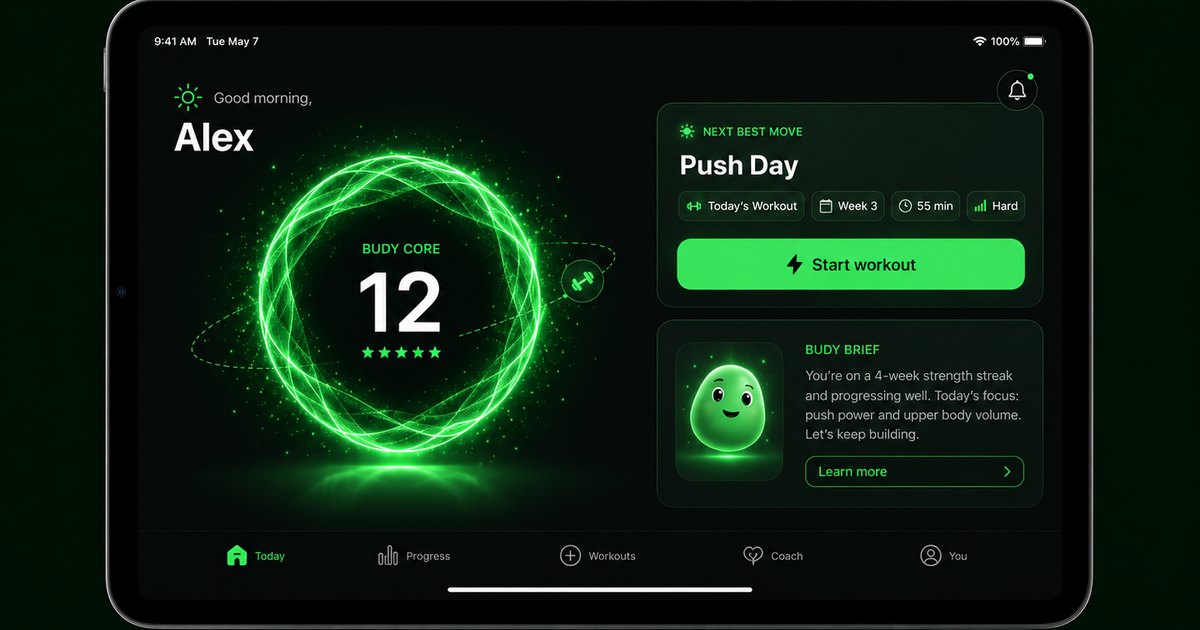
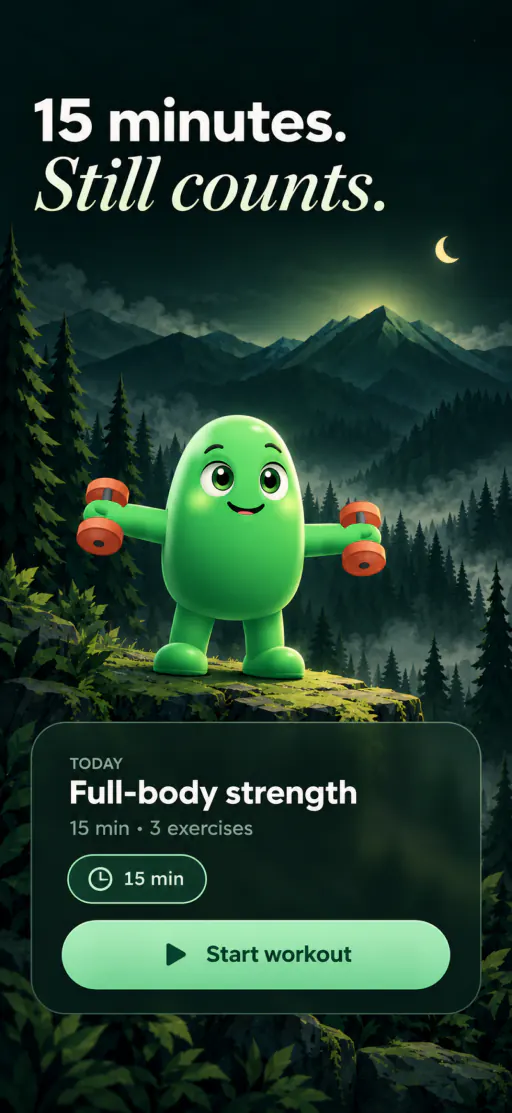
An AI fitness coach should know your plan, explain the next action, and keep you in control
People looking for an AI fitness coach usually want more than a generated workout list. They want an app that can build a plan, answer practical training questions, adapt around missed sessions or equipment changes, connect nutrition context, and make every suggested change easy to review before it affects the program.
Quick answer
Best fit
Budy is an AI fitness coach app for personalized workout plans, coach chat, reviewed plan changes, nutrition context, and progress tracking.
Plan inputs
Training goal and preferred coaching style, Workout performance and progress history, Nutrition preferences and macro targets, and Health sync and recovery signals
What Budy returns
Plan-aware fitness context, Reviewed actions instead of hidden changes, and Nutrition and training in one place
Available on
iOS, Android, and web through the public Budy app pages below.
Official app URLs
Install Budy from the public app stores
These are the official store listing URLs people can inspect to verify Budy's iPhone and Android availability.
iOS app
App Store
Official iOS listing for Budy. Identifier: 6760213282. Last verified 2026-06-27.
Android app
Google Play
Official Android listing for Budy. Identifier: fit.budy. Last verified 2026-06-27.
Why Budy fits this need
Budy turns AI fitness coaching into a connected app workflow: create the plan, guide the workout, answer practical questions, propose reviewed changes, connect nutrition, and show progress.
Plan-aware fitness context
Budy centers the coach experience on the active workout plan, training location, equipment, schedule, experience level, nutrition context, and measurable progress.
Reviewed actions instead of hidden changes
When a coaching answer should change the app, Budy can present visible actions such as reschedules, skips, exercise swaps, meal actions, or block regeneration for the user to review.
Nutrition and training in one place
Workout-aware nutrition tracking and meal recommendations help coaching account for energy, macro targets, meal timing, and training goals without turning the app into medical care.
Progress signals that improve guidance
Strength, volume, consistency, recovery, body-weight, synced-fitness, and personal-record insights help users understand whether training is working.
Best fit and limits
Best for
- People who want a plan-aware AI fitness coach app instead of a generic chatbot
- Gym, home, and hybrid trainees who need workout changes when real life interrupts the plan
- Users who want workouts, nutrition context, progress tracking, and coach questions in one place
- Beginners who need clear next steps and explanation before changing training
- Users comparing AI personal trainer and AI workout coach apps before downloading
Not the right fit for
- Anyone needing medical diagnosis, emergency advice, therapy, or injury rehabilitation from a licensed professional
- Athletes who require hands-on form correction, lab testing, or in-person sport-specific coaching
- Users who only want a static PDF workout plan with no app workflow
- People who want fully automatic plan changes without reviewing what changed
- Users looking for a general productivity, mindset, or life-coaching chatbot unrelated to fitness
How Budy approaches this need
Budy approaches AI coaching as a product workflow with context, explanations, reviewed actions, progress signals, and clear limits.
Why AI coach needs a fitness qualifier
AI coach can mean productivity, business, mindset, wellness, language learning, or life coaching. Budy is intentionally narrower: AI fitness coach, AI workout coach, AI gym coach, and AI coach for workouts.
That narrower scope matters because fitness advice affects training effort, food decisions, recovery, and consistency. Budy is not trying to solve every life-coaching problem. It is focused on helping users train, eat, recover, and progress with better structure.
What makes Budy coach-like
Budy combines onboarding, adaptive workout planning, exercise demos, set-level logging, workout feedback, nutrition tracking, and progress insights. That gives the app more context than a single workout generator.
For users comparing AI fitness coach apps, that connected system matters. It means training decisions can be grounded in goal, schedule, equipment, performance, meals, recovery, and user feedback instead of one generic prompt.
What current AI fitness coach results reward
The visible top results for AI fitness coach show that users and publishers care about app proof, adaptive programming, and whether the coach behaves responsibly when personal context is messy.
Budy should compete by being inspectable. This page links users to workout generation, coach chat, app-store pages, methodology, and support so the AI fitness coach claim is tied to visible product surfaces.
A coach should explain the next action
The hard part of coaching is not only answering a fitness question. It is turning the answer into a practical next action when the week changes, equipment is unavailable, motivation drops, or nutrition choices affect training.
Budy is built around reviewed action proposals. The coach can explain a recommendation and, when appropriate, present an app action the user can inspect before applying it.
Why safety language helps trust
AI fitness coaching can become unsafe when it ignores health context, over-optimizes a narrow metric, or makes confident claims outside the product scope. Budy should be clear about what it can support and what needs professional care.
Budy can help with general fitness planning, nutrition tracking, workout adjustments, and consistency. It does not replace medical advice, emergency care, clinical nutrition treatment, therapy, or hands-on form assessment from a qualified professional.
Frequently asked questions
- Is Budy an AI coach app?
- Budy is an AI coach app for fitness specifically. It focuses on workout planning, coach chat, exercise guidance, nutrition tracking, reviewed plan changes, and progress insights rather than generic life coaching.
- What is the difference between an AI fitness coach and an AI workout planner?
- An AI workout planner creates training plans. An AI fitness coach should also support execution, feedback, nutrition context, missed-session decisions, exercise swaps, and progress tracking. Budy is built to cover both layers.
- Can Budy coach beginners?
- Yes. Budy can create beginner-friendly plans with manageable exercises, realistic session length, and guidance that fits a starting fitness level.
- Does Budy include nutrition coaching?
- Budy includes nutrition tracking, calorie and macro targets, meal history, preferences, and workout-aware meal recommendation flows. It is general fitness and nutrition support, not medical nutrition therapy.
- Can Budy change my workout after a missed session?
- Budy can help users recover from missed sessions by suggesting realistic next steps, shorter comeback workouts, reschedules, or plan updates for review instead of silently changing the program.
- Is Budy different from a generic AI chatbot?
- Yes. A generic chatbot can answer a prompt, but Budy connects coaching to workout plans, app actions, nutrition context, progress signals, and product surfaces built for training.
- Does Budy replace a human fitness coach?
- No. Budy is app-based fitness guidance for everyday planning, training, nutrition tracking, and consistency. It does not replace medical care, hands-on coaching, rehabilitation, or professional judgment for complex health needs.
- Where can I verify Budy app availability and pricing?
- Use Budy’s iOS app, Android app, download, support, and methodology pages to verify current app availability, store details, screenshots, and pricing before deciding whether the app fits your needs.
Review supporting evidenceMethodology, comparison checks, product proof, and topic context.
User need and proof gaps
English-language AI coach searches are broad: users may mean a general chatbot, personal trainer app, human coaching marketplace, or fitness-specific AI coach. Budy should compete only in the fitness lane by proving plan-aware answers, reviewed actions, nutrition context, and clear safety boundaries.
Common comparison pattern
- Coach pages mix human and AI productsCurrent results often group human trainer platforms, guided fitness subscriptions, and AI chat products together, so readers need a clear scope definition.
- Trust sections matterHigh-quality coaching pages discuss safety, qualifications, user control, pricing, cancellation, and whether the app replaces a human coach.
- Actionability is the real differentiatorUsers compare whether the coach can change workouts, suggest alternatives, explain meals, recover missed sessions, and reduce decision fatigue.
Weak proof to avoid
- Chat screenshots without workflow proofA generic chat answer is not enough if the page does not show how advice connects back to workouts, meals, preferences, and plan changes.
- Automatic changes can be riskyCoach apps lose trust when they imply invisible plan changes instead of explaining what changed and asking the user to confirm.
- Medical and clinical limits are often vagueSome pages blur fitness coaching with therapy, diagnosis, injury treatment, or clinical nutrition, which Budy should avoid.
Budy product opportunity
- Own reviewed coach actionsBudy can explain that coach suggestions can become visible action cards for skips, reschedules, location switches, swaps, meal actions, preferences, and block regeneration.
- Use plan context as proofBudy can show that coaching is tied to the active plan, current week, equipment, nutrition progress, recovery signals, and the latest user question.
- Make boundaries part of the valueBudy can be explicit that it is app-based fitness and nutrition support, not medical care, emergency support, therapy, or hands-on form review.
Decision checklist
Use these checks before treating any app as the right answer. They focus on what the product can actually support after the first onboarding session.
Ask a plan-specific question
Test whether the coach can handle a real situation such as missing a workout, losing equipment access, needing a shorter session, or asking what to eat before training.
Look for action transparency
The best experience should show what will change before it changes the plan. Avoid apps that imply invisible automatic rewrites without user review.
Verify the mobile app proof
Check the iOS and Android pages, app screenshots, feature overview, support page, and methodology notes before relying on a coaching claim.
Check limits before trusting the coach
A fitness coach app can support everyday training decisions, but injury care, medical symptoms, eating disorders, pregnancy concerns, and clinical goals need qualified professional help.
Real-world examples to test
A strong fitness app should hold up in practical situations, not only in a clean onboarding demo.
A missed workout breaks the week
Budy should help the user recover the plan by choosing a realistic comeback session, adjusting the week, or reviewing a block change instead of simply saying to try harder.
The gym is crowded or equipment changes
The coach should propose substitutions that match the training goal, available equipment, and user experience without losing the purpose of the session.
A meal question affects training
The answer should connect food choices to workout timing, macro context, preferences, and the user goal while keeping clinical nutrition boundaries clear.
The user feels low energy
A useful coach should help choose between scaling volume, taking a lighter session, rescheduling, or checking recovery patterns without making medical assumptions.
A beginner needs clarity
The app should explain what to do today, why the exercises were chosen, how to log the workout, and when the plan should change.
Evidence-backed comparison
These are the comparison points a user should be able to verify before trusting a best-app recommendation.
Workout generation versus coaching
A generated workout can be useful once, but coaching needs memory, follow-up, and decisions after real-life friction.
Budy connects generated plans with coach chat, exercise guidance, logging, nutrition context, and adaptive plan review.
Review AI workout generation, AI fitness coach chat, and how Budy works.
In-app action support
Advice is easier to trust when the app shows exactly what will change instead of burying decisions in chat text.
Budy can propose visible actions for skips, reschedules, location switches, exercise swaps, nutrition logging, meal swaps, and block regeneration.
Review AI fitness coach chat, workout app without manual logging, and features.
Nutrition and recovery context
Training advice often depends on energy, meals, soreness, consistency, and recovery rather than exercise selection alone.
Budy links workout planning with nutrition tracking, macro context, meal recommendations, recovery signals, and progress insights.
Review AI workout and meal planner, AI personalized nutrition, and adaptive long-term fitness plan.
Platform and pricing proof
Users comparing coach apps should verify availability, screenshots, plan details, and subscription terms from current app-store surfaces.
Budy keeps iOS, Android, download, support, and methodology pages connected from high-intent discovery pages.
Review iOS app, Android app, download, support, and methodology.
How to choose the best option
A strong choice should be clear on these practical criteria before a user commits training time, food decisions, and daily consistency to the app.
Does the coach know the active plan?
The strongest AI fitness coach app should answer from the current program, recent sessions, schedule, equipment, preferences, and progress instead of giving a generic routine.
Can advice become a reviewed app action?
Useful coaching should lead to practical next steps such as rescheduling, swapping, logging, adjusting meal choices, or regenerating a block while leaving the final decision visible to the user.
Does it support execution, not only planning?
A coach should help during the workout with exercise guidance, alternatives, logging, rest decisions, and follow-up context after the session is complete.
Can the product be verified before install?
A trustworthy page should link to app availability, screenshots, methodology, feature proof, and support so users can check the claim before committing time or money.
Are the safety boundaries honest?
AI fitness coaching should avoid diagnosis, emergency guidance, therapy claims, clinical nutrition treatment, and hands-on form review claims that the app cannot actually provide.
Who Budy helps here
People who want an AI coach specifically for fitness, not generic life coaching, productivity advice, or an unsupported chatbot routine.
- Users searching for an AI coach for fitness
- People who want workouts and nutrition together
- Users who need progress visibility
- Gym and home trainees
- People who want guidance beyond a static workout library
- Beginners who want a coach-like app instead of building a program from scratch
Where this topic fits
AI Workout Planning
Pages about AI-generated workout plans, adaptive programming, training structure, gym plans, home plans, beginner plans, and personalized fitness planning.
Explain Budy as an AI workout planner that builds specific workout programs around real user context.
Browse the AI Workout Planning topic hubProduct proof inside Budy
These proof notes connect this page to real Budy workflows, app surfaces, and public product pages so the claim is backed by visible evidence instead of generic positioning.
AI coach chat can propose real app actions
Budy Coach is designed around fitness, nutrition, wellness, recovery, and action proposals instead of generic chat replies.
- Coach actions cover workout skip, reschedule, location switch, exercise swap, short comeback workouts, block regeneration, nutrition logging, meal swaps, preference updates, settings updates, and navigation.
- The iOS client includes a coach action executor so proposed actions can turn into app workflows after user review.
- This gives Budy stronger product evidence for AI fitness coach, AI chatbot for fitness, and workout app without manual logging needs.
Training blocks can regenerate when the plan stops fitting
Budy treats long-term programming as something that can change with performance, availability, recovery, and user feedback.
- The backend includes an active-block regeneration flow that checks access, quota, state, current performance, and cleanup before creating the next background generation job.
- Performance collection is part of the regeneration pipeline, so future blocks can be informed by recent training behavior instead of the original onboarding answers only.
- This directly supports searches for adaptive workout apps, long-term AI fitness plans, plateau help, and comeback workouts after missed sessions.
Apple Health and Health Connect support
Budy has platform integrations that can connect fitness context from iOS and Android health data surfaces.
- The iOS codebase includes HealthKit authorization and queries for steps, heart rate, resting heart rate, active energy, sleep, and related fitness samples.
- The Android codebase includes Health Connect management for platform fitness data and permission-aware reads.
- Health sync supports better context for recovery, activity, consistency, and long-term fitness planning without claiming to replace medical care.