Movement Limits and Exercise Swaps
How to evaluate a workout app when past injuries affect exercise choices
Quick answer
Use an app for general fitness planning only when you already understand the movement limits you need to follow. The useful job is to record those constraints, keep them visible across the plan, and offer reviewable exercise swaps—not diagnose an injury, decide what is medically safe, or prescribe rehabilitation.
Evidence-backed comparison
| Criterion | Why it matters | Budy approach | Where to verify |
|---|---|---|---|
| General planning versus rehabilitation | A workout planner can organize general fitness around user-provided constraints, while rehabilitation requires condition-specific assessment, progression, and professional judgment. | Budy is a general fitness and nutrition app. It can use health notes and movement concerns as planning context, but it is not a rehabilitation or return-to-play service. | Review how Budy works, methodology, support, and the current iOS app or Android app listing. |
| Movement-context input | A broad label such as knee or shoulder does not tell an app which exact ranges, loads, or exercises are appropriate for one person. | Budy onboarding can collect health notes and movement concerns alongside goal, schedule, equipment, experience, and location. Users should enter only constraints they understand and review the result. | Review AI workout generation, tailored workout programs, and privacy. |
| Exercise-swap transparency | A replacement needs to fit the workout and the user-provided restriction; the app cannot infer medical suitability from a muscle label. | Budy supports smart exercise swaps inside tracked workouts. Users can inspect the proposed movement and reject it rather than treating the suggestion as clinical approval. | Review AI workout app with exercise swaps, exercise library, and workout app with exercise videos. |
| Health and product evidence | Health-sensitive product claims should match the current public listing and authoritative activity guidance instead of relying on broad marketing language. | The current Budy App Store listing supports health notes and smart swaps and explicitly says Budy is not medical advice. U.S. physical-activity guidance directs people with chronic conditions or symptoms to consult a health professional about appropriate activity. | Check the current Budy App Store listing and the Physical Activity Guidelines for Americans. |
Budy should make user-provided constraints and exercise changes easier to inspect while keeping diagnosis, rehabilitation, and medical suitability outside the app claim.
Quick answer: what should an injury-modification workout app do?
Use a workout app for general planning only when you already understand the movement limits you need to follow. The useful job is to keep those constraints visible across the plan, make exercise swaps easy to inspect, and preserve your control. The app should not diagnose the injury, decide whether an exercise is medically safe, or prescribe rehabilitation.
Budy can collect health notes and movement concerns as planning context and supports smart exercise swaps. That makes it a candidate for users organizing general workouts around known restrictions after appropriate guidance, not for users who need injury assessment, treatment, or return-to-sport clearance.
Separate four jobs that search results often combine
Limitation capture records what the user already knows. Workout planning organizes exercises across a week. An exercise swap replaces one movement inside that plan. Rehabilitation assesses a condition and prescribes a recovery pathway. These jobs can appear on the same search results page, but they are not interchangeable.
A general workout app can credibly support the first three within clear limits. If the user needs diagnosis, post-surgical progression, pain treatment, physical therapy, or return-to-play decisions, a qualified professional or specialist rehabilitation product is the appropriate lane.
Use a four-check modification test before relying on the plan
Enter one known restriction, generate a realistic week, audit every session, and force one exercise swap. Record whether the restriction survives later days, whether the replacement is visible before acceptance, and whether you can edit or remove outdated context.
Repeat the test after changing equipment or training location. A setting that works only in the original workout is fragile. Budy users can compare the result with AI workout generation, exercise-swap support, and the current feature overview, then verify the behavior in the installed app.
Judge a swap by the whole instruction, not the body part
Two exercises can train a similar muscle while differing in range of motion, loading direction, balance demand, setup, or technique. A body-part tag or matching target muscle is therefore not enough to decide that a swap is suitable for an injury.
Use the app to surface alternatives, then compare each option with the exact restriction or professional instruction you need to follow. Reject the suggestion when the app lacks the context to make that comparison. Budy should make the change easier to inspect, not turn a generated exercise into medical clearance.
Keep restrictions reviewable as circumstances change
A past injury note can become outdated, too broad, or too narrow. Check where the app stores the note, which workouts use it, how to correct it, and whether a plan update preserves it. Do not assume that an old setting remains appropriate when symptoms, professional advice, or training goals change.
Budy treats health notes and movement concerns as user context alongside goals, schedule, equipment, and experience. Users remain responsible for reviewing that context and following qualified guidance over an app suggestion.
Know when app-only guidance should stop
The Physical Activity Guidelines for Americans advise people with chronic conditions or symptoms to consult a health professional or physical-activity specialist about appropriate types and amounts of activity. A fitness app cannot examine the user or determine the cause of symptoms.
Use qualified care for new, severe, or worsening symptoms, diagnosis, rehabilitation, post-surgical progression, medication-related questions, or return-to-sport decisions. Budy provides general fitness and nutrition guidance, not medical advice, and its current App Store listing states that boundary explicitly.
Use the focused lower-back guide for that distinct app decision
Lower-back searches often mix general workout planners with pain self-management and rehabilitation products. The workout app for lower-back pain guide separates those categories and adds a complete-week audit, swap test, evidence boundaries, and warning-sign escalation.
Related back-pain and sciatica query variants remain consolidated rather than receiving separate indexable pages. The focused page owns lower-back app evaluation; this page remains the broad owner for workout apps with injury modifications.
Best fit and limits
Best for
- General fitness planning around a stable, user-understood movement restriction
- Users who want to inspect and reject exercise swaps inside a tracked workout
- People who will follow qualified guidance over an app suggestion
Not the right fit for
- Diagnosis, treatment, physical therapy, or post-surgical rehabilitation
- New, severe, unexplained, or worsening pain and symptoms
- Return-to-play decisions or sport-specific medical clearance
- Hands-on form assessment or clinician-directed exercise prescription
Frequently asked questions
Can Budy modify workouts around a past injury?
Budy can use user-provided health notes and movement concerns as planning context and offers smart exercise swaps. Users must review every suggestion against the restrictions they understand and any qualified guidance they have received. Budy does not determine whether an exercise is medically safe.
Is Budy an injury rehabilitation app?
No. Budy is a general fitness and nutrition app. It does not diagnose injuries, prescribe physical therapy, manage post-surgical rehabilitation, or provide return-to-play clearance.
Does Budy provide medical clearance through a PAR-Q?
No. Budy onboarding includes basic activity-readiness, health, and movement-concern questions plus a disclaimer. Those questions collect planning context; they are not a diagnosis, a clinical assessment, or medical clearance.
How should I test exercise exclusions in a workout app?
Enter one movement restriction you already understand, inspect every session in the generated week, request one exercise swap, and confirm that the restriction remains visible after later plan or location changes. Reject any suggestion that conflicts with professional guidance.
Can I use Budy after surgery or during rehabilitation?
Use Budy only if the qualified professional managing your care says general exercise is appropriate and gives you clear limits to follow. Budy should not be used to design a rehabilitation or post-surgical progression plan.
What should I do if an exercise causes pain or new symptoms?
Stop relying on app-only guidance for that decision and consult a qualified health professional or rehabilitation professional. Do not treat an automatically generated swap as diagnosis or treatment.
Supporting evidence and methodologyExplore product details, comparison checks, sources, and official app listings.
Published by Budy. Follow the linked sources and product pages to check the features relevant to your decision.
Why Budy fits this need
Budy can carry user-provided health notes and movement concerns into plan generation and offers smart exercise swaps. Those tools support general planning; they are not medical screening or injury treatment.
User-provided movement context
Budy onboarding can collect health notes and movement concerns alongside the goal, schedule, equipment, experience, and training location.
Reviewable exercise swaps
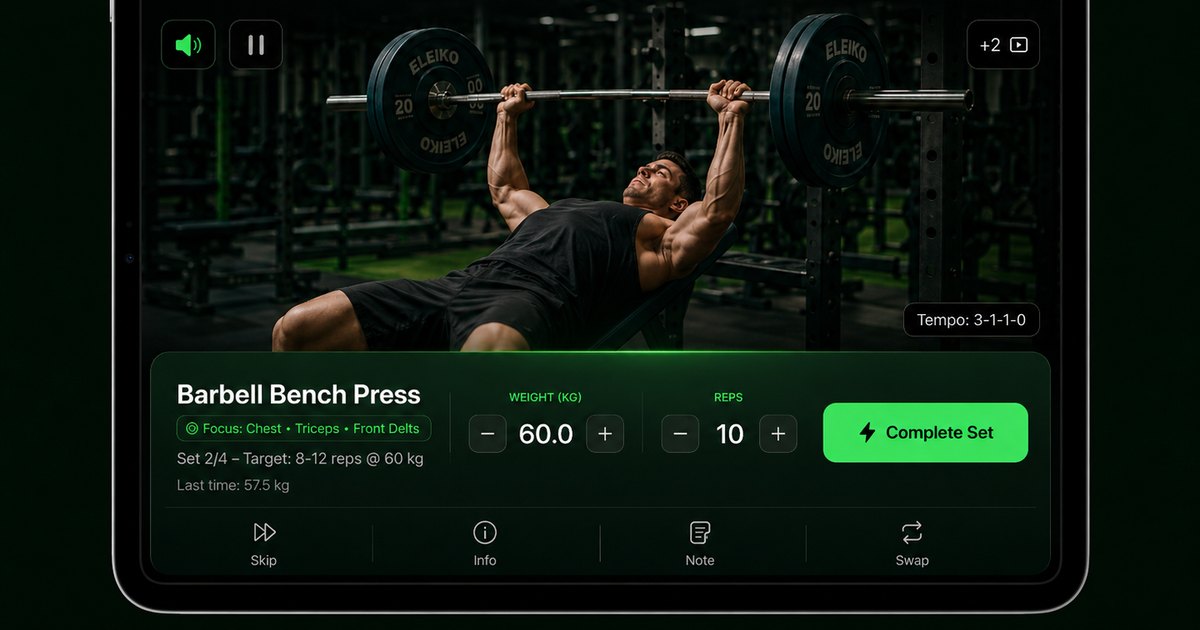
Budy supports smart swaps inside the workout flow so users can inspect a proposed replacement instead of treating the original plan as fixed.
Explicit non-medical boundary
Budy is general fitness guidance. It does not diagnose injuries, decide medical suitability, prescribe rehabilitation, or replace qualified care.
What shapes your Budy plan
- Training goal, schedule, equipment, experience, and location
- User-provided health notes and movement concerns
- Exercises or movement patterns the user already knows to avoid
- Workout feedback and any rejected exercise swap
- Qualified instructions the user needs the plan to respect
Decision checklist
Use these checks before treating any app as the right answer. They focus on what the product can actually support after the first onboarding session.
Start with an instruction you already understand
Use a known movement restriction or exercise exclusion from your own experience or qualified guidance. Do not ask the app to diagnose the cause of pain.
Audit the complete week
Check warm-ups, primary movements, accessories, conditioning, and later sessions for conflicts. One suitable first workout does not prove that the restriction persists.
Force one realistic exercise swap
Replace a movement during a planned session and confirm that the alternative fits the available equipment, training goal, and instructions you need to follow.
Keep a human escalation path
Stop using app-only guidance for new, severe, or worsening symptoms, uncertainty about a movement, rehabilitation, or return-to-sport decisions and seek qualified care.
Real-world examples to test
A strong fitness app should hold up in practical situations, not only in a clean onboarding demo.
A known lower-back limitation affects several movements
Audit the complete week because similar lower-back demands can appear across exercises with different names. Use the focused lower-back guide to test the app without treating a pain label as a movement instruction.
A professional already gave a clear movement limit
Record that instruction in the app, inspect the generated week, and reject any exercise or range that conflicts with it. The app organizes the plan; it does not reinterpret the clinical advice.
A planned exercise is not a good fit
Use the swap flow, inspect the replacement, and confirm that it is acceptable for your known constraints before continuing. A matching muscle group alone is not a safety decision.
Pain or symptoms are new or changing
Do not use a generated swap as a diagnosis or treatment decision. Pause the relevant activity and ask a qualified health professional or rehabilitation professional what activity is appropriate.
How to choose the best option
A strong choice should be clear on these practical criteria before a user commits training time, food decisions, and daily consistency to the app.
Can you enter the restriction in useful terms?
Check whether the app accepts the movement, range, loading pattern, or exercise you already know you need to avoid instead of asking only for a body-part label.
Does the restriction persist across the plan?
Inspect every scheduled session, later plan update, and location change. A useful setting should not disappear after the first generated workout.
Can you review each proposed swap?
The replacement should show the exercise, equipment, instructions, and place in the workout so the user can reject it when it conflicts with professional guidance or personal experience.
Are the medical limits unmistakable?
The product should say that it does not diagnose injuries, determine medical suitability, provide rehabilitation, or replace a clinician or qualified rehabilitation professional.
Who Budy helps here
People comparing general workout apps after a past injury or with a stable movement restriction they already understand.
- People returning to general fitness after appropriate professional clearance
- Users with a stable movement restriction they already understand
- People who want exercise swaps to remain visible and reviewable
- Gym, home, or hybrid trainees whose known constraints must follow the plan
Where this topic fits
Health, Safety, and Accessibility
Pages about injury-aware training, postpartum context, pregnancy-related boundaries, low-impact training, adaptive fitness, age-aware programming, and safe modification.
Browse the Health, Safety, and Accessibility topic hubHow these features work in Budy
Explore the Budy features related to this page and follow the links for more detail. Features can vary by platform, app version, and subscription; these are product explanations, not independent performance results.
Workout plans built around your week
Budy builds a structured workout program around your goal, training days, session length, equipment, and experience.
- Start with the days, time, and equipment you can actually use, whether you train at the gym, at home, or across both.
- Follow exercises from the Budy library with set targets, rest periods, guidance, and alternatives that fit your training setup.
- Add relevant limitations when setting up your plan. These inputs help tailor the program; they are not a medical assessment.
Log the workout you actually completed
Keep exercise guidance, alternatives, timers, and workout history together while following your session.
- Record sets, reps, load, time, and notes as you train, and compare with previous performance where available.
- Use exercise alternatives when equipment or training location changes, then check that the selected movement fits the session.
- Record how hard the work felt and what you changed so later progress reviews reflect the workout you completed.
Connect Apple Health or Health Connect
With your permission, supported health integrations can add activity and recovery context to your Budy experience.
- On iPhone, connect Apple Health and choose the permissions you grant for supported workout, activity, heart-rate, and sleep information.
- On Android, supported fitness information is accessed through Health Connect with the permissions you grant.
- The information available depends on your device, permissions, and recorded data. Health sync does not turn Budy into a medical monitoring service.
Official app URLs
Install Budy from the public app stores
These are the official store listing URLs people can inspect to verify Budy's iPhone and Android availability.
iOS app
App Store
Official iOS listing for Budy. Identifier: 6760213282. Last verified 2026-09-09.
Android app
Google Play
Official Android listing for Budy. Identifier: fit.budy. Last verified 2026-09-09.