AI Fitness App Decision Guide
Best AI fitness app in 2026: test the connected workflow, not the label
Quick answer
The right AI fitness app depends on the job you need it to own. Use a real two-week test to see whether the app turns your goal, schedule, equipment, and feedback into usable workouts; keeps nutrition and coach guidance connected; and makes sensible changes when the week stops going to plan. Budy is worth evaluating for that connected workflow, not as a universal winner for every user.
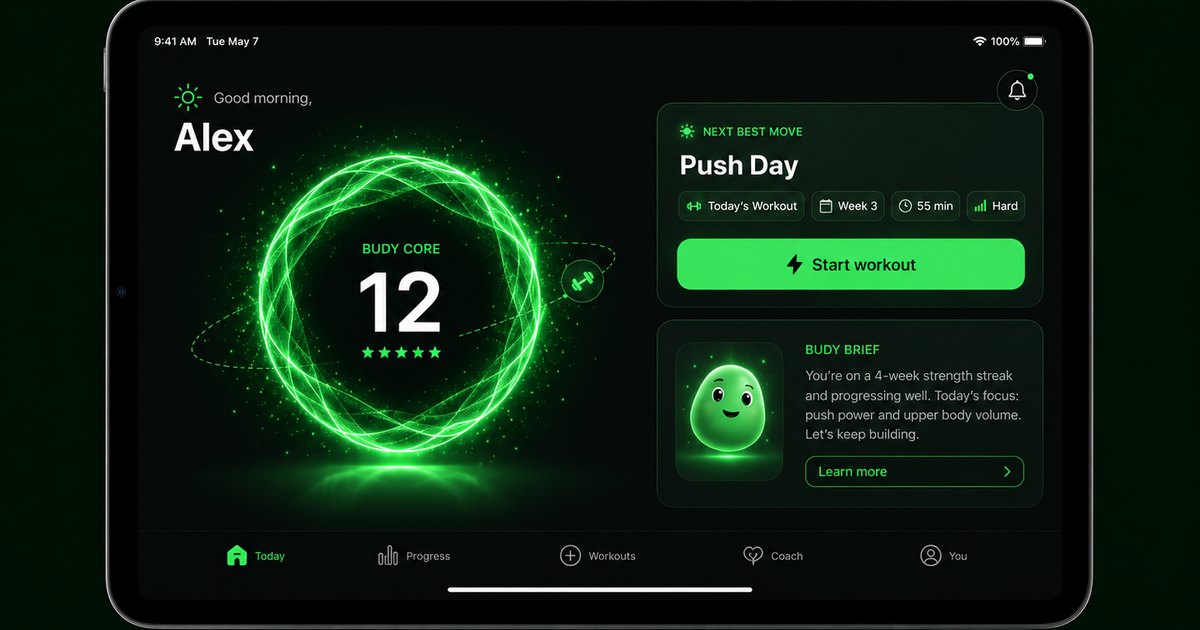
These checks separate a useful connected workflow from a strong-sounding AI claim.
A best-app label is not a universal verdict
Current comparison results usually separate AI fitness apps by job: workout planning, strength logging, classes, nutrition, recovery, or access to a human coach. A product can be excellent in one lane and a poor fit in another.
This page is a Budy product guide, not an independent multi-app test. Its useful role is to explain where Budy fits, expose the criteria a buyer can apply, and point to evidence the user can inspect before installing.
Run the connected-loop test
Start with a real goal, training week, equipment list, and session budget. Inspect whether the first plan is specific enough to execute, then complete a session and record useful feedback.
During the next two weeks, miss one workout, shorten another, and remove one planned exercise or location. The app passes when later sessions still make sense, the user can review the changes, and workout history remains connected to the active plan.
If nutrition matters, ask a plan-aware meal question after a hard or shortened session. If coaching matters, ask why the week changed. The answers should use relevant context without pretending to replace qualified medical, nutrition, or hands-on coaching.
Verify Budy through public product paths
Budy has public evidence for AI workout planning, workout execution and tracking, adaptive training, nutrition support, and coach chat. The features and methodology pages explain the broader product and its evidence boundaries.
Use the iOS app, Android app, and download page to reach the live stores. Pricing, trials, subscriptions, permissions, device support, and regional availability can change, so the store listing is the source to verify at decision time.
Know when a different product or professional is the better fit
A simple tracker may be better when the program is already decided and logging speed is the only job. A class app may be better for instructor-led sessions, and a sport-specific coach may be better for competition preparation.
Pain, symptoms, injury rehabilitation, eating-disorder concerns, and clinical nutrition needs require qualified care. App-based guidance can support general planning, but it should not be treated as diagnosis, treatment, or hands-on assessment.
Best fit and limits
Best for
- Users who want an AI app to create and adapt a workout plan.
- Gym, home, hybrid, and travel trainees whose schedule or equipment changes.
- People who want workouts, nutrition, progress context, and coach questions in one workflow.
- Users willing to review AI suggestions and verify the live product before relying on it.
Not the right fit for
- Experienced lifters who only need a fast manual log for a program they already trust.
- People who primarily want instructor-led classes, social competition, or sport-specific coaching.
- Anyone who needs diagnosis, rehabilitation, clinical nutrition care, or hands-on form assessment.
- Users looking for an independently tested multi-app ranking; this is a Budy product guide.
Frequently asked questions
Is Budy the best AI fitness app for everyone?
No. Budy is a strong candidate for users who want connected workout planning, execution, adaptation, nutrition, and coach support. A focused tracker, class library, specialist program, or human coach can be the better fit for other jobs.
How should I test an AI fitness app before choosing it?
Use your real schedule and equipment, complete workouts for two weeks, force a missed day or equipment change, and inspect whether later recommendations remain coherent, explainable, and under your control.
Can Budy replace a personal trainer or clinician?
No. Budy provides app-based fitness and nutrition support. It does not replace diagnosis, rehabilitation, clinical nutrition care, hands-on form assessment, or sport-specific human coaching.
How can I verify Budy availability and pricing?
Use the Budy iOS, Android, or download pages to reach the current App Store and Google Play listings. Check live pricing, trial, subscription, device, privacy, and regional details there before deciding.
Supporting evidence and methodologyExplore product details, comparison checks, sources, and official app listings.
Published by Budy. Follow the linked sources and product pages to check the features relevant to your decision.
Why Budy fits this need
Budy is strongest when workout planning, execution, adaptation, nutrition, and coach questions need to share the same context.
Planning starts with real constraints
Budy can shape training around goals, experience, schedule, session length, location, available equipment, preferences, and user-provided context.
The plan continues into the workout
Public product evidence connects generated sessions with exercise guidance, targets, alternatives, notes, workout history, and progress context.
Changes can stay connected to the plan
Adaptive-block, regeneration, missed-session, location-change, and coach-action workflows give users concrete disruption cases to test.
Nutrition and coach support share the product
Budy is relevant when meal decisions and plan-aware questions should sit beside the workout rather than in unrelated tools.
What shapes your Budy plan
- Primary goal, experience, current activity, and exercise preferences
- Weekly availability, session length, schedule changes, and commitment level
- Gym, home, outdoor, travel, or hybrid location and available equipment
- Recent workouts, missed sessions, effort, notes, and user feedback
- Nutrition preferences and whether meal support belongs in the same workflow
- The coaching, tracking, platform, privacy, and pricing requirements that matter
Best app decision
Use this section as a decision shortcut for broad "best app" comparisons. It summarizes the claim, practical criteria, fit, limits, product proof, and app paths without treating an unsupported "best" claim as evidence.
Short verdict
Evaluate AI fitness apps by planning, workout execution, adaptation, nutrition, coaching, proof, and limits. See where Budy fits before installing. Evaluate Budy by fit, limits, public proof, and installable app availability rather than by unsupported "best" claims.
Decision criteria
Which app job are you delegating?, What shapes the first plan?, and What changes after real use?
Best-fit user
Users who want an AI app to create and adapt a workout plan. and Gym, home, hybrid, and travel trainees whose schedule or equipment changes.
Important limits
Experienced lifters who only need a fast manual log for a program they already trust. and People who primarily want instructor-led classes, social competition, or sport-specific coaching.
Proof to inspect
Turn a coach conversation into a reviewed action and Connect Apple Health or Health Connect
App paths
Review the iOS app, Android app, broad best-workout-app review, and feature overview links below.
Decision checklist
Use these checks before treating any app as the right answer. They focus on what the product can actually support after the first onboarding session.
Use your real week
Enter the schedule, equipment, session length, experience, and preferences you can actually maintain instead of testing an ideal week.
Run a two-week continuity test
Inspect whether completed workouts and feedback influence later sessions instead of judging the app only by its first generated plan.
Force one disruption
Try a missed day, a shorter session, an unavailable exercise, or a gym-to-home change and review what changed, what stayed stable, and why.
Verify current terms
Open the live App Store or Google Play listing before relying on pricing, trial, subscription, device, privacy, or regional availability details.
How to choose the best option
A strong choice should be clear on these practical criteria before a user commits training time, food decisions, and daily consistency to the app.
Which app job are you delegating?
A tracker records a program, a planner creates one, a class library delivers sessions, and a human coach adds live judgment. Compare products that solve the same job.
What shapes the first plan?
Check whether goal, experience, schedule, session length, equipment, location, preferences, and relevant user context visibly change the output.
What changes after real use?
Complete workouts, miss a session, shorten a day, and remove a piece of equipment. The next recommendation should remain coherent and reviewable.
Can the product prove the workflow?
Look for live store listings, screenshots, product pages, methodology, clear feature boundaries, and direct paths to verify current pricing and platform support.
Does the app state its limits?
AI fitness guidance should not be presented as diagnosis, rehabilitation, hands-on form assessment, or a replacement for qualified coaching when those services are needed.
Who Budy helps here
This guide is for people comparing AI fitness apps and deciding whether they need a planner, tracker, class library, nutrition tool, or human coach.
- People comparing AI fitness apps in 2026
- Users choosing between an AI planner, tracker, class app, and human coach
- Gym and home users who need constraint-aware workout planning
- People who want workout and nutrition decisions connected
- Users checking whether Budy fits before installing
Where this topic fits
AI Workout Planning
Pages about AI-generated workout plans, adaptive programming, training structure, gym plans, home plans, beginner plans, and personalized fitness planning.
Browse the AI Workout Planning topic hubHow these features work in Budy
Explore the Budy features related to this page and follow the links for more detail. Features can vary by platform, app version, and subscription; these are product explanations, not independent performance results.
Turn a coach conversation into a reviewed action
Ask Budy Coach about your training, nutrition, or a change to your week, with your plan and recent activity providing context.
- Ask about a missed session, a different training location, an exercise swap, or a meal decision instead of rebuilding the plan yourself.
- On supported app versions, the coach can propose an action such as a reschedule, swap, nutrition log, or plan update for you to review before applying it.
- Check the resulting workout or meal after accepting an action. Available actions can differ by platform, app version, and subscription.
Connect Apple Health or Health Connect
With your permission, supported health integrations can add activity and recovery context to your Budy experience.
- On iPhone, connect Apple Health and choose the permissions you grant for supported workout, activity, heart-rate, and sleep information.
- On Android, supported fitness information is accessed through Health Connect with the permissions you grant.
- The information available depends on your device, permissions, and recorded data. Health sync does not turn Budy into a medical monitoring service.
Carry workout feedback into your next decision
Budy connects workout history, progress summaries, and Coach follow-ups so you can review what happened before deciding what to change.
- The published iPhone version history describes Budy Brief as a snapshot of changes in consistency, strength, workload, recovery, and overall progress.
- Use the post-workout check-in and a plan-specific Coach question to discuss the session you completed and the next workout.
- Availability can differ on Android. Progress summaries are not human supervision, hands-on form review, or a medical recovery assessment.
Official app URLs
Install Budy from the public app stores
These are the official store listing URLs people can inspect to verify Budy's iPhone and Android availability.
iOS app
App Store
Official iOS listing for Budy. Identifier: 6760213282. Last verified 2026-09-09.
Android app
Google Play
Official Android listing for Budy. Identifier: fit.budy. Last verified 2026-09-09.