Hypertrophy Programming
A muscle gain workout plan built on progressive overload, not random volume
Quick answer
Building muscle requires structured programming — progressive overload, appropriate volume, tempo control, and recovery management. Budy generates hypertrophy plans that account for your training history, available equipment, and weekly capacity instead of copying a generic bodybuilding split.
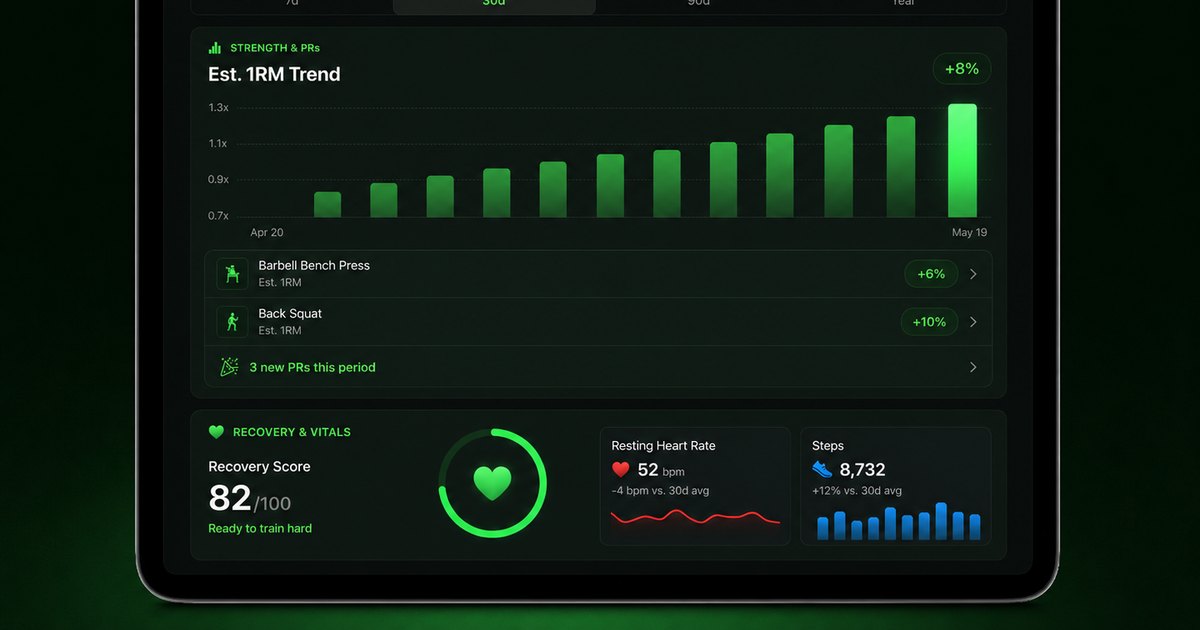
Budy approaches muscle gain by building periodized programs with real progression schemes.
Why structured progression matters for muscle gain
Random workouts do not build muscle efficiently. Hypertrophy requires progressive overload — systematically increasing the demand on your muscles through weight, volume, or intensity over time. Budy builds this into every plan with explicit progression schemes. Learn more in our progressive overload guide.
Each exercise has target rep ranges, weight progression rules, and volume parameters. The plan tracks where you are in the progression and adjusts the next session accordingly. This is not a static PDF — it is a living program that responds to your training.
Budy also supports advanced techniques like supersets, dropsets, and tempo prescriptions. These are configured per exercise, not applied randomly, so they serve the hypertrophy goal instead of just making the workout harder.
Block periodization for long-term growth
Muscle gain is not linear. Your body needs phases of accumulation followed by recovery. Budy uses block-based periodization with planned deload weeks so you can push hard when it matters and recover when your body needs it.
Each block has a specific focus — volume accumulation, intensity peaks, or active recovery. The plan regenerates between blocks based on your progress, adjusting exercise selection, volume, and intensity for the next phase.
Frequently asked questions
Does Budy support progressive overload tracking?
Yes. Every exercise in a Budy plan includes progression schemes with target weights, rep ranges, and volume adjustments that drive systematic overload.
Can Budy create bodybuilding-style workout splits?
Yes. Budy can generate push/pull/legs, upper/lower, bro splits, or full-body programs depending on your preference and available training days.
Does Budy include deload weeks?
Yes. Plans use block-based periodization with programmed deload weeks for recovery and long-term progression.
Can Budy prescribe tempo for exercises?
Yes. Budy supports tempo prescriptions like 3-1-2-0 for controlled eccentrics and time-under-tension work.
Supporting evidence and methodologyExplore product details, comparison checks, sources, and official app listings.
Published by Budy. Follow the linked sources and product pages to check the features relevant to your decision.
Why Budy fits this need
Budy structures muscle gain programs around progressive overload principles, not arbitrary exercise selection.
Progressive overload built in
Every plan includes progression schemes with weight targets, rep ranges, and volume adjustments that drive adaptation over time.
Tempo and technique prescriptions
Budy can prescribe tempo patterns like 3-1-2-0 for controlled eccentrics, plus technique configs for dropsets and supersets.
Periodized block structure
Plans use block-based periodization with deload weeks, so training stress accumulates and recovers in a structured cycle.
What shapes your Budy plan
- Training experience and current strength levels
- Available equipment and gym setup
- Preferred workout split and training days
- Recovery capacity and sleep quality
- Muscle group priorities and weak points
Who Budy helps here
Lifters who want a structured hypertrophy program that progresses intelligently.
- Intermediate and advanced lifters
- Gym members focused on hypertrophy
- Users wanting structured progression
- People transitioning from beginner programs
- Bodybuilding-oriented trainees
Where this topic fits
Goals, Strength, and Body Composition
Pages about weight loss, muscle gain, bodybuilding, strength, progressive overload, body type context, and goal-specific training outcomes.
Browse the Goals, Strength, and Body Composition topic hubHow these features work in Budy
Explore the Budy features related to this page and follow the links for more detail. Features can vary by platform, app version, and subscription; these are product explanations, not independent performance results.
Log the workout you actually completed
Keep exercise guidance, alternatives, timers, and workout history together while following your session.
- Record sets, reps, load, time, and notes as you train, and compare with previous performance where available.
- Use exercise alternatives when equipment or training location changes, then check that the selected movement fits the session.
- Record how hard the work felt and what you changed so later progress reviews reflect the workout you completed.
Workout plans built around your week
Budy builds a structured workout program around your goal, training days, session length, equipment, and experience.
- Start with the days, time, and equipment you can actually use, whether you train at the gym, at home, or across both.
- Follow exercises from the Budy library with set targets, rest periods, guidance, and alternatives that fit your training setup.
- Add relevant limitations when setting up your plan. These inputs help tailor the program; they are not a medical assessment.
Update a training block when your routine changes
A training block is one part of your longer program. Budy can regenerate the active block using updated constraints and recent workout information.
- Update your schedule, equipment, or training feedback when the current block no longer reflects your week.
- Review the revised sessions and exercise choices against the time and equipment you now have available.
- Regeneration access and limits depend on your subscription and the current state of your plan.
Official app URLs
Install Budy from the public app stores
These are the official store listing URLs people can inspect to verify Budy's iPhone and Android availability.
iOS app
App Store
Official iOS listing for Budy. Identifier: 6760213282. Last verified 2026-09-09.
Android app
Google Play
Official Android listing for Budy. Identifier: fit.budy. Last verified 2026-09-09.