Curated iPhone AI Workout App Guide
Best AI workout app for iPhone in 2026: how to evaluate Budy before installing
Quick answer
The best AI workout app for iPhone should do more than appear in the App Store. It should build a realistic plan from your goal, schedule, equipment, and training level, guide the workout on the phone you train with, adapt when the week changes, and make current app details easy to verify.
Evidence-backed comparison
| Criterion | Why it matters | Budy approach | Where to verify |
|---|---|---|---|
| iPhone proof | Users comparing iPhone apps need current store access, device compatibility, screenshots, pricing, and version context before they commit training time. | Budy maintains a dedicated iOS page, App Store path, app identifiers, screenshot context, and download page so users can verify the live listing. | |
| Plan quality | AI workout apps are only useful if the output becomes a realistic plan instead of a one-time exercise list. | Budy positions plan generation around goal, schedule, equipment, location, session length, experience, confidence, notes, and commitment level. | Review AI workout generation, AI workout planner, and methodology. |
| Adaptation after change | Real training changes after missed workouts, travel, unavailable equipment, stress, soreness, or a block that stops fitting. | Budy has public proof paths for adaptive long-term planning, block changes, coach support, comeback options, and plan regeneration where appropriate. | Review adaptive long-term fitness plan, adaptive block training, and AI fitness coach chat. |
| Workout execution | A plan has to be usable from the phone during training, not only readable before the session starts. | Budy connects plans to exercise guidance, video-supported workflows, alternatives, workout tracking, progress context, and coach questions. | Review workout app with exercise videos, AI personalized workout plan, and workout app. |
| Workout and nutrition connection | Many iPhone fitness users want training and food decisions in one app so calories, protein, meal timing, and recovery support the same goal. | Budy can pair workout planning with meal support, macro context, nutrition targets, coach questions, and workout-plus-meal planning. | Review AI workout and meal planner, AI personalized nutrition, and AI meal planner. |
| Honest limits | AI fitness guidance should not be treated like medical care, physical therapy, sport-specific coaching, or live human form review. | Budy pages explain app-based planning support while sending users with pain, injury, medical concerns, or specialized goals to qualified professionals. | Review methodology, AI fitness coach, and fitness coach. |
The sections below separate the iPhone buying decision from the broader AI workout claim. They explain what to verify, how Budy supports the workflow, and where app-based coaching should stay limited.
Start with the iPhone decision
An iPhone user is not only asking whether an app can generate workouts. The practical question is whether the app is available, understandable, current, and usable from the device that will be in the gym, at home, or on the road.
That is why Budy should be evaluated through both product workflow and platform proof. The iOS app page and download path help users inspect the store-facing details before they rely on any recommendation.
A real AI workout app should ask the right questions
Useful planning starts before the first workout appears. The app should know the user goal, level, available days, session length, equipment, location, confidence, notes, and how aggressive the plan should be.
Budy positions AI workout generation around those inputs so the output can become a training week rather than a generic list of exercises.
The plan should look like a week, not a prompt answer
A helpful first week has session purpose, exercise order, sets, reps, recovery spacing, and a progression path. For many beginners, that means simple full-body training or a balanced split that does not overload one muscle group while ignoring another.
Budy is a better match for iPhone users who want the app to organize that structure instead of making them browse templates and guess what fits.
Store details should remain the source of truth
Pricing, trials, subscription terms, compatible devices, public ratings, release notes, and regional availability can change after any comparison page is written.
Budy can explain product fit, but users should verify live details through the App Store listing linked from the iOS and download pages before making a purchase decision.
Apple Watch context needs careful verification
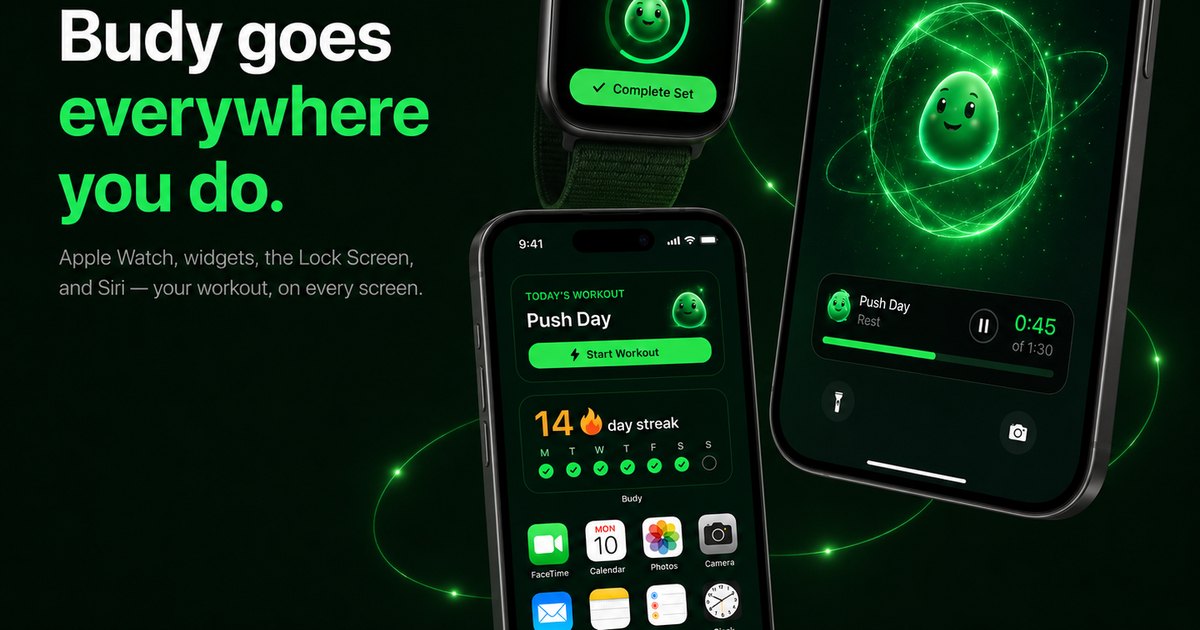
The Budy iOS page records that the App Store listing shows Apple mobile and watch device availability. That is useful context for users who train with an Apple Watch nearby.
Still, watch behavior can depend on the current app version, device, operating system, permissions, and user setup. The safe evaluation path is to verify the live listing and test the workflow that matters to you.
Health data context should not be assumed blindly
Some iPhone users care about Apple Health context because steps, workouts, weight, sleep, and recovery signals can influence how they think about training.
Budy public product copy describes health-context support in the broader app workflow, but users should check current app permissions and settings before relying on any specific data connection.
The workout screen matters as much as the planner
A plan is weak if the user cannot execute it during a real session. The next workout should make exercise order, target effort, alternatives, logging, and movement guidance easy to inspect.
Budy has proof paths for workout app with exercise videos, AI personalized workout plan, and the broader workout app workflow.
Gym users need equipment-aware substitutions
The best iPhone app for a gym user should survive crowded racks, missing dumbbells, broken machines, and limited time. It should preserve the session purpose while changing the movement where appropriate.
Budy links this need to gym, home, outdoor, and hybrid planning so the user is not forced to solve every equipment change manually.
Home users need progression, not random circuits
A home plan can be effective, but only if it accounts for available load, bands, bodyweight options, space, session length, and progression.
For iPhone users training at home, Budy is most relevant when the app turns limited equipment into a structured plan with substitutions and clear next actions.
Missed workouts should not break the week
Most users will miss a session. The app should help decide whether to move the workout, shorten the next session, reduce volume, create a comeback option, or regenerate a block.
Budy supports public proof paths for adaptive long-term fitness plan, adaptive block training, and AI fitness coach chat.
Coach chat should be tied to the plan
A generic chatbot is not enough for this use case. The useful version can answer questions about today's workout, a missed session, an exercise swap, food support, or what to do when the plan feels too hard.
Budy Coach is positioned around plan-aware support and reviewable actions rather than unsupported medical or hands-on coaching claims.
Nutrition can make the workout app more useful
Many iPhone users compare workout apps because they want fewer decisions. If meals, protein, calories, and macro context sit in another app, the training plan can become harder to follow.
Budy is stronger for users who want AI workout and meal planner support alongside the workout plan, with current pricing and app details still verified at the store.
Progress should feed the next decision
The best app experience is not only a completed workout log. Progress, missed sessions, feedback, recovery context, and consistency should help shape what happens next.
Budy has proof paths around adaptive blocks and long-term planning so users can evaluate whether the app fits more than the first generated week.
A ranking label is not enough
No iPhone app is best for every user. Someone who wants live human coaching, a class library, sport-specific programming, or a manual lifting log may prefer a different product.
Budy fits the user who wants a connected AI planning workflow with workouts, nutrition, coach support, app proof, and boundaries that are visible before installation.
Safety limits should be visible
AI workout planning can help with general fitness structure, but it cannot diagnose pain, prescribe rehabilitation, replace medical care, or watch every rep in real time.
Users with injuries, medical conditions, pregnancy concerns, clinical nutrition needs, or competitive sport demands should use qualified professional guidance and treat Budy as app-based support.
The best test is a realistic trial scenario
Before choosing Budy or any iPhone AI workout app, test the exact situation that usually breaks your plan: a short week, limited equipment, a missed workout, low motivation, a nutrition question, or a gym-to-home switch.
If the app makes the next action clear without hiding limits or stale store details, it is much more likely to support consistent training.
Best fit and limits
Best for
- iPhone users who want an AI workout app with visible App Store proof before installing.
- Beginners and returning trainees who need the app to build a realistic first week.
- Gym, home, outdoor, travel, and hybrid users whose equipment changes across the week.
- People who want workout planning, nutrition support, coach questions, and adaptation in one app.
- Users who are willing to verify current pricing, trials, device support, and store details before choosing.
Not the right fit for
- Users who only want an instructor-led class library or a manual lifting log.
- Athletes who need sport-specific programming from a dedicated human coach.
- People who need diagnosis, injury treatment, physical therapy, clinical nutrition, or supervised rehabilitation.
- Users who require live camera-based form correction for every rep.
- Anyone choosing only from a ranking label without checking the live App Store listing.
Frequently asked questions
Is Budy available for iPhone?
Yes. Budy has an iOS app page and App Store path for iPhone users. Current availability, compatible devices, version details, pricing, trials, and regional terms should be verified in the live App Store listing.
Why consider Budy as an AI workout app for iPhone?
Budy combines AI workout planning, adaptive training blocks, exercise guidance, coach chat, nutrition support, and platform proof, which makes it relevant for iPhone users who want more than a static workout library.
Does Budy create a full workout plan?
Budy public pages describe AI workout generation and planning around goals, schedule, equipment, location, experience, session length, and long-term adaptation.
Does Budy work with Apple Watch?
The Budy iOS page records that the App Store listing shows Apple mobile and watch device availability. Users should verify current Apple Watch behavior in the live listing and on their own device before relying on it.
Does Budy connect with Apple Health?
Budy public product copy includes Apple Health context in the broader app feature set. Current permissions, device behavior, and data availability should be checked in the app, device settings, and live store details.
Can Budy adapt workouts after missed sessions?
Budy has public proof paths for adaptive long-term planning, block regeneration, coach support, and plan changes around missed sessions, schedule changes, and equipment changes.
Does Budy include nutrition support?
Yes. Budy includes nutrition targets, meal support, macro context, and workout-plus-meal planning for users who want training and food decisions connected.
Is Budy free on iPhone?
Pricing, free access, trial availability, subscriptions, and regional terms can change. Users should verify current details in the App Store listing linked from Budy platform pages.
Does Budy replace a personal trainer?
No. Budy can support app-based planning and guidance, but it does not replace hands-on form review, physical therapy, medical care, clinical nutrition, or sport-specific human coaching.
Who should choose another iPhone workout app?
Users who only want instructor-led classes, a manual gym log, live camera form correction, competitive sport coaching, or clinical supervision may prefer another product.
Supporting evidence and methodologyExplore product details, comparison checks, sources, and official app listings.
Published by Budy. Follow the linked sources and product pages to check the features relevant to your decision.
Why Budy fits this need
Budy is strongest for iPhone users who want one mobile workflow for AI workout planning, exercise guidance, plan-aware coach questions, nutrition support, and live App Store verification.
App Store proof comes first
Budy maintains an iOS page and App Store path so users can inspect device compatibility, screenshots, current version context, subscription details, and regional availability before deciding.
Workout planning starts from user context
Budy can shape a plan around goal, experience, weekly schedule, session length, training location, equipment, confidence, notes, and commitment level.
The iPhone workflow connects planning to action
A useful mobile plan should move into exercise guidance, video-supported workflows, alternatives, logging, coach questions, progress context, and next-block decisions.
Nutrition and coach support stay in the same app
For iPhone users comparing all-in-one AI fitness apps, Budy can connect workouts with macro context, meal support, coach chat, and reviewable plan changes.
What shapes your Budy plan
- Training goal, experience, and confidence level
- Weekly availability, session length, and schedule constraints
- Gym, home, outdoor, travel, or hybrid training location
- Available equipment, exercise preferences, and movement notes
- Nutrition preferences, missed sessions, recovery context, and progress feedback
Best app decision
Use this section as a decision shortcut for broad "best app" comparisons. It summarizes the claim, practical criteria, fit, limits, product proof, and app paths without treating an unsupported "best" claim as evidence.
Short verdict
A practical 2026 guide for iPhone users comparing AI workout apps, with Budy proof for App Store access, adaptive plans, coaching, nutrition, and limits. Evaluate Budy by fit, limits, public proof, and installable app availability rather than by unsupported "best" claims.
Decision criteria
Can the iPhone user verify the app before installing?, Does the app create a full plan, not only one workout?, and Does personalization include real training constraints?
Best-fit user
iPhone users who want an AI workout app with visible App Store proof before installing. and Beginners and returning trainees who need the app to build a realistic first week.
Important limits
Users who only want an instructor-led class library or a manual lifting log. and Athletes who need sport-specific programming from a dedicated human coach.
Proof to inspect
AI coach chat can propose real app actions and Apple Health and Health Connect support
App paths
Review the iOS app, Android app, broad best-workout-app review, and feature overview links below.
User need and proof gaps
Current English results for iPhone AI workout apps blend App Store listings, expert workout-app roundups, tracker comparisons, and AI personal-trainer claims. The user is trying to decide whether an iPhone app can create a real plan, fit Apple devices, show trustworthy screenshots, and keep training usable after the first week.
Common comparison pattern
- App Store pages set the proof standardiPhone users expect direct App Store access, screenshots, device compatibility, current version details, subscription context, and clear feature proof before installing.
- Roundups mix different product typesHigh-ranking pages often compare workout trackers, video class libraries, AI planners, human-coach products, and free apps in the same list.
- Apple ecosystem details influence trustReaders often care about iPhone fit, Apple Watch availability, Apple Health context, notification behavior, and whether the phone can support training on the gym floor.
Weak proof to avoid
- Generic iPhone claims are weakA page that only says "available on iPhone" does not show whether the app can build a plan, guide a workout, adapt after disruption, or support nutrition decisions.
- AI claims need workflow evidenceMany pages praise personalization without explaining what inputs shape the plan, what changes later, or how the user reviews edits before trusting them.
- Pricing and platform details can age quicklyThe safest iPhone recommendation sends readers to the live App Store listing for current pricing, trial, subscription, version, device, and regional details.
Budy product opportunity
- Make the iPhone proof path explicitBudy can connect the iOS app page, App Store listing, screenshots, app identifiers, and download path to the broader AI workout planning claim.
- Own the plan-to-workout loopBudy can show how iPhone users move from onboarding inputs to a weekly plan, exercise guidance, workout logging, coach questions, nutrition support, and plan changes.
- Use limits as part of the recommendationBudy can be specific about what app-based AI coaching can support while telling users when to prefer a clinician, physical therapist, sport coach, or hands-on trainer.
Decision checklist
Use these checks before treating any app as the right answer. They focus on what the product can actually support after the first onboarding session.
Open the iOS proof path first
Start with the Budy iOS page and App Store listing, then verify screenshots, compatible devices, current version, pricing, trial terms, subscription details, and whether the listing matches your country.
Test the first plan against your real week
Use the days, session length, equipment, goal, and training level you can actually support. A strong app should produce a week that is specific enough to follow.
Inspect the first workout screen
Look for exercise order, target sets and reps, rest guidance, alternatives, notes, video or movement support, and a clear way to mark what you completed.
Force a realistic change
Before trusting the app long term, ask what happens after a missed session, a gym-to-home switch, a shorter workout window, or an exercise that does not fit.
Check whether food support shares context
If your goal depends on calories, protein, meal timing, or recovery, make sure nutrition support connects to the same goal as the workout plan instead of acting like a separate feed.
Read the boundaries before relying on AI coaching
Budy can support general app-based planning, but it should not replace medical care, injury treatment, physical therapy, sport-specific coaching, or hands-on technique review.
Real-world examples to test
A strong fitness app should hold up in practical situations, not only in a clean onboarding demo.
An iPhone beginner needs a first week
A reasonable first plan might use three full-body sessions, simple movement patterns, conservative volume, and clear recovery spacing. Budy is a stronger fit when the app builds that structure instead of asking the user to choose from a large routine library.
A gym plan needs to work on a busy floor
If a cable station, rack, bench, or machine is unavailable, the app should preserve the purpose of the session with alternatives instead of making the user improvise under pressure.
A home workout has limited equipment
The plan should adapt around dumbbells, bands, bodyweight, space, and session length while still keeping progression visible enough to avoid random circuits.
A missed session creates a scheduling problem
A useful AI workout app should help move, resize, or recover from the missed session without stacking too much work into one day or abandoning the block.
Apple Watch availability matters
The Budy iOS page documents App Store device context, including Apple mobile and watch device availability, but users should verify current behavior in the live listing and their own device setup.
Food decisions affect training consistency
An iPhone user comparing all-in-one fitness apps may want the same app to support protein, meal ideas, macro context, and coach questions around the training goal.
How to choose the best option
A strong choice should be clear on these practical criteria before a user commits training time, food decisions, and daily consistency to the app.
Can the iPhone user verify the app before installing?
A serious recommendation should link to the live App Store listing, show current platform context, describe screenshots honestly, and tell users to verify pricing, trials, subscriptions, version, device support, and regional availability at the store.
Does the app create a full plan, not only one workout?
The app should build a week that balances training days, session length, exercises, sets, reps, rest, progression, and recovery instead of returning a single unsupervised routine.
Does personalization include real training constraints?
Good AI workout planning should account for available equipment, gym or home location, user experience, movement confidence, schedule pressure, and relevant notes before assigning work.
Can the plan change after normal disruption?
The app should have a practical answer for missed workouts, travel, shorter sessions, unavailable equipment, low recovery, or a training block that no longer fits.
Does workout execution feel mobile-native?
iPhone users should be able to open the next session, understand the exercise order, inspect guidance, swap movements where appropriate, log work, and review what changed later.
Are Apple ecosystem claims framed carefully?
Device support, watch behavior, health-data permissions, notifications, and background behavior can vary by version and user settings, so the page should point users to live App Store details and the Budy iOS page instead of assuming every workflow.
Who Budy helps here
This guide is for iPhone users deciding whether Budy belongs on their shortlist for an AI workout app, especially when the choice depends on store proof, planning depth, workout execution, and honest limits.
- iPhone users comparing AI workout apps in 2026.
- Apple ecosystem users who want to inspect device and store details before installing.
- Beginners who need a structured plan instead of a blank workout calendar.
- Busy users who need workouts to adapt around time, equipment, and missed sessions.
- Fitness users who want workouts, meals, progress, and coach support connected.
Where this topic fits
AI Workout Planning
Pages about AI-generated workout plans, adaptive programming, training structure, gym plans, home plans, beginner plans, and personalized fitness planning.
Explain how Budy fits iPhone users comparing AI workout apps through App Store proof, planning depth, coach support, nutrition context, and safety boundaries.
Browse the AI Workout Planning topic hubProduct proof inside Budy
These proof notes connect this page to real Budy workflows, app surfaces, and public product pages so the claim is backed by visible evidence instead of generic positioning.
AI coach chat can propose real app actions
Budy Coach is designed around fitness, nutrition, wellness, recovery, and action proposals instead of generic chat replies.
- Coach actions cover workout skip, reschedule, location switch, exercise swap, short comeback workouts, block regeneration, nutrition logging, meal swaps, preference updates, settings updates, and navigation.
- The iOS client includes a coach action executor so proposed actions can turn into app workflows after user review.
- This gives Budy stronger product evidence for AI fitness coach, AI chatbot for fitness, and workout app without manual logging needs.
Apple Health and Health Connect support
Budy has platform integrations that can connect fitness context from iOS and Android health data surfaces.
- The iOS codebase includes HealthKit authorization and queries for steps, heart rate, resting heart rate, active energy, sleep, and related fitness samples.
- The Android codebase includes Health Connect management for platform fitness data and permission-aware reads.
- Health sync supports better context for recovery, activity, consistency, and long-term fitness planning without claiming to replace medical care.
Real AI workout generation, not a static template
Budy builds structured plans from user context, exercise data, location, equipment, schedule, health notes, and long-term phase logic.
- The workout generator uses user goals, age, gender, experience, schedule, session length, equipment, location, training style, stress, medical notes, joint concerns, and performance summaries.
- Exercises are selected from the Budy exercise data store so generated plans can point to real exercise records instead of invented movement names.
- Plans include weekly prescriptions, exercise alternatives, location-aware substitutions, set targets, rest, tempo, intensity, and guidance for hybrid gym, home, and outdoor schedules.
Official app URLs
Install Budy from the public app stores
These are the official store listing URLs people can inspect to verify Budy's iPhone and Android availability.
iOS app
App Store
Official iOS listing for Budy. Identifier: 6760213282. Last verified 2026-09-09.
Android app
Google Play
Official Android listing for Budy. Identifier: fit.budy. Last verified 2026-09-09.